

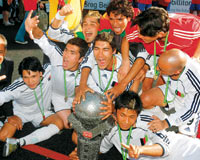
More than 5,000 crammed into the temporary stadium in Federation Square to watch Afghanistan beat Russia 5-4 in the men's final last Sunday. Prior to the thrilling Afghanistan-Russia final, Zambia won the inaugural Women's World Cup by trouncing Liberia 7-1 in a one-sided game. The Africans, who dominated their competition all week, have set the benchmark other female teams will aim for next year.
As we mentioned in our preview to this tournament on Nov. 16, the aim of the Homeless World Cup is not to humiliate these deprived people. Quite the contrary, it is a world-class international tournament that uses soccer as a catalyst to help the homeless change their lives -- and to change the attitudes of governments, the media and the public to create better solutions for homelessness around the world.
The annual Homeless World Cup is now in its sixth year and, as it was in the beginning, there are a few routes to qualify -- none of them easy. Players must be over 16 and have been homeless at some point in the past year or earn their main income as a street paper vendor, be an asylum seeker or be in drug or alcohol rehabilitation and have been homeless at some time in the past two years.
Using a regulation size ball, street football is played at a frenetic pace in two seven-minute halves on a compact, hard surface field, with teams of four -- including a goalkeeper.
Tryouts for the tournament are held every year in each participating nation and are advertised in street papers, through posters and on notice boards in hostels and housing organizations. Research conducted by the organizers six months after last year's tournament in Copenhagen points to the impact the Homeless World Cup has on the lives of those involved.
Of the 381 players who took part in Copenhagen, 71 percent said the experience significantly changed their lives, 93 percent said they had a new motivation for life, 83 percent had improved their social relations, 29 percent had found employment and 32 percent had entered some form of education.
Finn Bradshaw, writing on the Homeless World Cup Web site, described the " Afghan party" after the men's final: " The sounds of A-F-G, A-F-G echoed around Federation Square as Afghanistan and its supporters celebrated victory in the 2008 Homeless World Cup. ... Deserving winner, Afghanistan was undefeated all week and also beat Russia in the group stage. The Central Asians took the tournament by storm both with their inspired play and their devoted legion of fans, which turned every match into a party."
On the footpath behind Federation Square Stadium, the Afghan players joined their adoring fans for a wild, joyous dance, while next to them Zambia stood in a circle with their Australian chaperones singing traditional African folk songs in sweet, strong voices.
The first Homeless World Cup was held in Graz, Austria, in 2003 with 18 teams. Subsequent cups in Göteborg, Sweden; Edinburgh, Scotland; Cape Town, South Africa; and Copenhagen, Denmark, have seen participation, its profile and the necessary corporate and private sponsorship steadily grow.
Homeless World Cup supporters include UEFA, the United Nations, Manchester United, Real Madrid and former France international player Eric Cantona as Cup ambassador. Next year, the tournament heads to Milan, Italy. You'd say the Italians have a lot to live up to, but when an event is such a strong, boisterous celebration of human nature -- however trite that might sound -- the organizing committee has nothing to worry about.
Turkey definitely must not be an absentee next year. There's nothing to lose and everything to gain.


