

These violations have reached such a point that recently, when a woman was dragged from a restaurant by her hair in İstanbul's Avcılar district by members of a gang disguised as police officers, bystanders in the restaurant did not react because it seemed to them that it might be normal for police to act like that.
On the other hand, for the first time ever in Turkey, the minister of justice apologized on behalf of the government to the family of an inmate who was killed in prison.
Violence at mass May Day demonstrations in İstanbul and in pro-Kurdish areas in October represented other problematic incidents in the field of human rights. But it was not just security forces that violated human rights: A rising trend of lynching attempts were one of the main concerns of human rights activists this year. Despite this year having been the 60th anniversary of the Universal Declaration of Human Rights, there were relatively few positive steps taken to fix the human rights situation in Turkey. Amendments were made to the infamous Article 301 of the Turkish Penal Code (TCK), which was considered one of the main obstacles to freedom of expression in the country, but these changes were not regarded as sufficient by human rights activists. A growing human rights problem in Turkey, the status and living conditions of illegal migrants and asylum seekers, reached a peak, but few progressive steps were taken.
Security forces and their 'excessive power'
According to the Human Rights Association (İHD), in 2008 eight people were killed in custody and 36 died in prison in Turkey. Nine people were shot to death for allegedly not obeying security forces' orders to halt.
Engin Çeber, who had been detained for distributing political pamphlets and killed while in custody, became the symbol of increased security force brutality. He died from a brain hemorrhage after reportedly being beaten by police officers and guards in İstanbul's Metris Prison on Oct. 7. Justice Minister Mehmet Ali Şahin apologized to Çeber's family in the name of the government. Unlike similar cases in the past, the justice system was quick to open court cases against the persons allegedly responsible for Çeber's death and against those who failed to prevent it. Forty-two people -- including six prison guards, four gendarmes, one doctor and 13 police officers -- have been charged with involvement in Çeber's death. The defendants will stand trial on Jan. 21.
Actually, in recent years the Turkish government has made progress in stamping out torture and abuse of detainees within the scope of its ongoing EU reforms. It also adopted a " zero tolerance for torture" policy, but after changes to a law in June 2007 that gave police broad powers to use lethal force and encouraged arbitrary searches, the use of violence by security forces has increased, according to an annual report from Human Rights Watch (HRW). The same report stressed that there was also an increase in disproportionate use of police force against demonstrators, including a readiness to fire at demonstrators, and excessive force during identity checks.
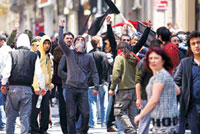
One of the demonstrations in which police were accused of using excessive force were the May Day celebrations in İstanbul. Labor unions had requested to use Taksim Square for their May Day demonstrations, but the government rejected the request, citing " possible provocations." Nevertheless, some groups attempted to take to the streets in Taksim anyways and more than 500 people were detained; at least six policemen, as well as dozens of demonstrators, were injured in the protests.
The prohibitive stance adopted by the government in rejecting the labor unions' demands led some to question its pro-freedom credentials. At the time, many commentators said the ruling Justice and Development Party (AK Party), which is sometimes criticized for turning to democracy and freedom only when these principles serve its purposes, could have used May Day as an opportunity to prove its democratic commitment, but missed the opportunity.
Other mass demonstrations were held this year in the first two weeks of October in response to rumors that outlawed Kurdistan Workers' Party (PKK) leader Abdullah Öcalan, who is serving a life sentence on the prison island of İmrali, had suffered abuse.
The illegal protests, mainly in the predominantly Kurdish Southeast, but also in İstanbul, left one Kurdish protester dead in the eastern city of Doğubeyazıt and several protesters and police officers wounded.
The appearance of children at the front lines of some of the events -- many of which were violent demonstrations involving clashes with police forces and destruction of property -- disturbed many across the nation, as citizens condemned the PKK for stopping at nothing, not even the exploitation of children, to perpetrate its campaign of terror. But, on the other hand, five children who were arrested for participating in such demonstrations were allegedly abused and are still in prison on charges of PKK membership, with the prosecutor demanding 23-year prison sentences for them.
Article 301 amended
Regarding freedom of expression, the disputed Article 301 was changed in Parliament in May. The article, which had been used to prosecute a number of writers and intellectuals, including Nobel Prize-winning author Orhan Pamuk, for " insulting Turkishness," was amended to require the justice minister's permission before opening a case; however, the approval requirement has not had a huge impact, as intellectuals and human rights defenders had predicted during the discussions about the amendment.
Since the amendment passed, the Justice Ministry has approved court cases for 70 out of the 519 requests for prosecution under the revised Article 301.
Another kind of human rights violation that was on the rise in 2008 was lynching attempts against Kurds. Kurdish workers were subjected to attacks, according to a report from the Turkish Human Rights Foundation (TİHV).
Sociologist Tanıl Bora stressed that a tendency toward lynchings against Kurds is already strong in Turkish society. There have been many examples of it, even to such an extent that lynching is about to become a " routine" occurrence. Bora also points out that the male youth of the society are affected by this atmosphere most. " Male adolescents, if they are unable to cope with their strong emotions, which is the case in Turkey, and if they are unable to develop a sense of empathy, which is also very difficult in Turkey due to the curriculum of national education -- based on enemy images and possible threats -- it is normal to expect that they will tend to go wild. TV series in Turkey contribute to this mood even further," he explains.
Ethnic rifts in the fabric of Turkish society intensified in 2008, particularly following terror attacks carried out by the PKK. These rifts reached a peak in October after attacks on a military outpost in Şemdinli and a police shuttle bus in Diyarbakır. Different segments of society were provoked and set off against each other in mutual hostility all over the country, even in cyberspace. There was an ethnic clash in Balıkesir-Altınova in which two people died. In the province of Iğdır there was a rash of anti-Kurdish graffiti; in Fethiye Turks and Kurds were on the verge of clashes and in an Ankara high school there was a fight between leftist and rightist students. In Denizli e-mails were sent out to users urging boycotts of shops owned by Kurds. Even on the Facebook.com social networking site, many anti-Kurdish groups emerged.
Yusuf Alataş, a lawyer and former chairman of the İHD, claims that such incidents are primarily a result of the attitude of the state. " For a long time, people have been hearing propaganda aimed at provoking negative sentiments. When the first lynching attempts took place several years ago, instead of preventing them or punishing the perpetrators, the security forces and the state sided with them," he says. On Facebook.com, groups with titles such as " The best Kurd is a dead one" and " The problem is not Kurdish, but Kurdish occupation of Turkish land" have been established. Another group that shares pictures of dead PKK members allegedly tortured by Turkish soldiers formed under the name " The exhibition of carrion of the PKK from the great successes of the heroic Turkish army.
Another tough area for human rights in Turkey was the situation of illegal migrants. More than 50,000 illegal migrants were captured in Turkey and there were several uprisings in migrant shelter houses, one of which resulted in the death of an immigrant in Kırklareli.
Excerpts from Turkey's human rights record for 2008
Feb. 15: Sixteen-year-old Yahya Menekşe was crushed to death by a police vehicle while demonstrating at an illegal protest in Cizre.
Mar. 22: Zeki Erik was shot by police fire during protests in the midst of the Nevruz festival and killed on the spot. Ramazan Dal, who was badly injured by police clubs in the same demonstration, died in the hospital 10 days later.
May 1: Many people, including two journalists, were injured as a result of police brutality during May Day protests in İstanbul.
Oct. 10: Engin Çeber died in Metris Prison after being taken into custody for distributing leftist magazines. The reason for his death was established as torture.
Oct. 20: Ahmet Özhan was killed by police gunfire during a pro-Kurdistan Workers' Party (PKK) demonstration in Ağrı.
Oct. 27: Eighteen-year-old Çağdaş Gemik was killed by police as he rode his motorbike in Antalya for not obeying a police officer's order to stop.
Nov. 11: Fourteen-year-old Ahmet Yıldırım was wounded in Adana by a gunshot fired by a police officer who accused the young boy of stealing a motorbike.
Nov. 19: Soner Çankal was shot to death in Ankara's Altındağ district for not obeying a call to halt by the police.
AYŞE KARABAT


