

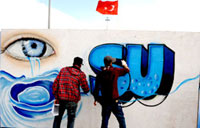
With a main theme of " Bridging Divides for Water," the forum is being held at the newly renovated Sütlüce Culture and Conference Center with the participation of the water and environment ministers of 180 countries and the heads of 25 nations, in addition to other attendees. Nearly 30,000 people, including more than 17,000 foreigners, have registered to attend the event.
Held once every three years and considered the largest global water-related event, the forum has been held in Morocco (1997), the Netherlands (2000), Japan (2003) and Mexico (2006). The forum is the largest international meeting hosted by Turkey in terms of number of participants since the UN Habitat II conference in 1996.
" The water situation in the world is not going in the right direction. ... There is a matter of urgency to act," said Ger Bergkamp, director general of the World Water Council, which organizes the forum.
The World Water Council describes the forum as follows: " Serving as stepping-stones towards global collaboration on water problems, the Forum is a unique platform where the water community and the policy and decision makers from all regions of the world can link together, debate and attempt to find solutions to achieve water security." The prince of Monaco, the presidents of Iraq, Somalia and Tajikistan, the prime ministers of Azerbaijan, Kyrgyzstan, Morocco, South Korea and Tuvalu, the crown prince of the Netherlands and a former prime minister of Japan are among the participants of the forum. A Greek Cypriot minister is also expected to participate in the ministerial-level part of the forum. President Abdullah Gül received Tajik President Emomalii Rahmon at the Çırağan Palace yesterday.
Prime Minister Recep Tayyip Erdoğan met with Iraqi President Jalal Talabani, Tajik President Rahmon and South Korean Prime Minister Han Seung-soo.
Based in Marseilles, the World Water Council has 340 members from 65 countries. The group was founded by water specialists and international organizations to exchange ideas about the conservation and development of water resources and encourage governments to lend political clout to solutions.
The " İstanbul Water Consensus" is expected to be signed during the forum. The İstanbul Water Consensus, a non-binding document of principles, invites mayors and local government leaders to make a united commitment to urban water resource management in the face of global changes. The first part of the consensus is a declaration, and the second part is a specific commitment designed to be tailored to the circumstances of the individual city or local authority.
Among the main aims of the forum, which will run through March 22, are raising the importance of water on the political agenda, supporting discussions towards the solution of international water issues in the 21st century, formulation of concrete proposals to solve water-related problems and generation of political commitments to this end. The forum will also cover topics such as drought and global climate change and the links between water and the health, energy and agriculture sectors.
A water expo and fair will be opened during the forum, and Prime Minister Erdoğan is expected to give awards for stories that inform the nation about the theme of the forum.
Besides the sessions and panels, the World Water Forum will also host various events such as a children's forum, a youth forum, a learning center, a speakers' corner, a partnership bazaar and an event called " Water & Films."
The forum is additionally expected to contribute to the promotion of Turkey, and particularly of İstanbul, and bring the country economic vitality at a time of global financial turmoil.
ICRC urges facilitation of war victims' access to water
The International Community of the Red Cross (ICRC) has called on the international community to ensure that the victims of armed conflict have access to safe water and sanitation in a written statement.
The statement said the ICRC was calling on governments taking part in the 5th World Water Forum to make a serious commitment to protect water and sanitation systems in times of war and to maintain services in conflict-prone areas to prevent them from collapsing.
" Water, sewage and electrical power systems, along with medical facilities, are usually the first things to be disrupted when a war breaks out," said Robert Mardini, who heads the ICRC's water and habitat unit. " They can be damaged or shut down completely by shelling and explosions, or overwhelmed by influxes of displaced people. Such incidents are often followed by massive shortages and by rapidly spreading disease that can result in loss of life." Mardini cited Iraq, Gaza, Sri Lanka and Somalia as examples of places where the delivery of water supplies and sanitation services had been severely hampered by recent armed conflicts.
Roughly a quarter of the estimated 1.2 billion people unable to obtain clean drinking water, and 15 percent of the 2.6 billion without access to proper sanitation, are in war-torn countries. " Access to safe water and adequate sanitation are fundamental for conflict-affected people," said Mardini. " The ICRC aims to use the World Water Forum to put this issue higher up the international agenda and to remind governments of their responsibilities in this respect."
Alternative forum opposes commercialization of water
Several nongovernmental organizations have accused the World Water Forum of serving as a vehicle for big water companies to promote their own interests through privatization, denying the " human right" to water in impoverished communities around the world.
" An Alternative Water Forum," bringing together activists who oppose the commercialization of water, will hold various workshops on issues ranging from water management and pricing to relations between dietary habits and water until March 22.
The forum, to be attended by representatives of local and international nongovernmental organizations and opposition political parties, will take place at Bilgi University's Santral İstanbul campus. The forum claims that the World Water Forum serves the purpose of commercialization of water, thus will begin today with a workshop titled " Water is life, It cannot be sold."
Organizers of the event aim at raising awareness in the public for the protection of water resources and protection of personal rights against the commercialization of these resources.


