

Turkey has the potential for transforming its opportunities into wealth, but as an irony of fate it also has a mechanism for squandering these opportunities. This is mechanism is like a hunter who accompanies his friends on a hunt in the wilderness but who scares away all the game, leaving nothing for his friends to hunt.
This mechanism also breeds losses.
These losses consist of costs incurred as well as opportunities missed. You can add to this the widening gap of your balance sheet compared to that of your rivals.
The biggest of these losses is the worsening quality of democracy. The years of profit and loss during the history of the republic clearly show this threat: The wasted years of the single party era until 1946... The stolen years between 1946 and 1950 characterized by the strange "open voting and closed counting" system...
In 1950 the whole country said "Stop! The nation will have the final say." It was a year of profit, although it was hampered by the jealousy of the single party mentality.
The years between 1960 and 1963 were years when the politicized law executed the prime minister it hated and caused the national will to suffer trauma.
The years between 1964 and 1970 were wasted because of the "center-right project." The 1970s were sacrificed to a military memorandum, coalition governments and terrorism.
The first half of the 1980s were wasted on the military guardianship of Sept. 12, but we also show the years of the Özal government in the profit column.
As the late President Turgut Özal was trying to move the country into the international league, his party was conquered by the status quo, and with his death in 1993 the country returned to the years of loss. Once again it saw coalition governments, the military guardianship of Feb. 28, postmodern interventions and the like.
In late 2003 the national will loudly raised its voice against these developments, saying once again 53 years later, "Stop the years of loss." Despite this, efforts for a military coup were secretly being exerted.
With the Council of State attack and debates over an early election in 2006, the hunter mechanism took the stage once again. It was claimed that 2007, when Parliament was unable to elect a president, was about to be added to the loss side of the column. A newspaper that is as old as the republic ran the headline "Are you aware of the danger?" on a black background for weeks. The memorandum of April 27 came. The law was abused in order to find a justification for the "367 quorum." Parliament was prevented from electing a president, and in the ensuing early elections, the whole country backed its stance of 2003.
That stance was for a civilian constitution. We entered 2008 with these wishes; however, a closure case was brought against the ruling party, and most of the year was spent in debates over the case. The government escaped closure, but the country's economy sustained considerable damage when the global economic crisis started. And 2008 was added to the list of lost years.
These years saw 15 economic crises. In every period of crisis, new abusers came on the scene and new exploiters were added to the crisis lobby. Now there is a new crisis, and its lobby is seeking to obtain unfair gains. It seems that Turkey is one step closer to the opportunities it failed to take advantage of before the crisis.
Turkey has emerged as a safe haven while many financial centers are losing their prestige. While the world's strongest economies are on the verge of collapse in the biggest financial crisis in a century, the Turkish financial system stands erect.
If Turkey manages to draft a civilian constitution for improving the quality of its democracy and implement the national program, and if these reforms normalize relations among the judiciary, bureaucracy and politicians, 2009 will be a year of profit.
Government faces strong opposition on ratification of Kyoto
Turkey was to take part in the Kyoto meeting in Poznan, Poland, in early December as a party to the convention. The opportunity was missed because the bill to ratify the protocol was not discussed in Parliament.
A three-month pending period at the UN is required after adoption of the draft at Parliament's plenary session. To do this, deliberations and discussions over the draft should have been completed by July. Back then, the opposition parties were not so opposed to the initiative. Nurettin Canikli from the Justice and Development Party (AK Party) asserts that they had an agreement with the opposition for rapid action. Canikli further says: "In fact, we should have been one of the initial signers of the protocol. The reasons put forward for the delay were not actually justified because if this is a proper initiative and if a price needs to be paid for it, we have to take this step. If we are obligated to make this world a livable place, we have to do this. We need to do this for the coming generations. We have to do this because of our obligations to God. We are detrimental to the perfection of the earth; human beings are destroying the world; we have no right to do this."
In 2008 an opportunity was missed to ratify the Kyoto Protocol. We will see whether this will be made up in 2009.
Why was Ankara mayor Gökçek's nomination delayed?
The delay in the nomination of the AK Party's candidate for mayoral elections in Ankara is considered an indication of how the local elections will shape 2009.
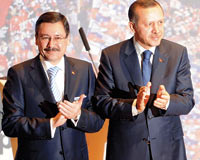
Melih Gökçek, known for his ability to pick his rivals, expected that his name would be announced earlier. However, Prime Minister Erdoğan announced his nomination in the fourth round instead of the first. This delay made Gökçek's nomination one of the most heated discussions in the back corridors of politics. I have seen a number of politicians who bet a suit and tie on it.
Because I argued in this column that Gökçek's nomination was inevitable, I also received an offer of a bet. A friend of mine who knows the AK Party well was so sure that Gökçek would not be nominated that he bet 20 people a suit. He, of course, lost the bet, but his reasons were worth considering.
A lot has been said about the delay. However, the venue where his nomination was announced attracted a great deal of attention. While Erdoğan announced the nomination of other candidates in various places, Gökçek's nomination was made public at AK Party headquarters. This was both a message and a response to reports alleging that Gökçek had hurt the party administration.
Israel's big mistake
Israel is insisting on committing a big mistake by spilling the blood of innocent people. However, this mistake is actually inconsistent with its explicit or implicit, publicized or unpublicized, goals, unless its primary goal is to disrupt peace and attract the hatred of the people.
ALİ ASLAN KILIÇ


