

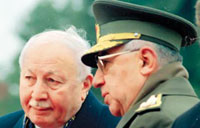
The recording, which was posted on a news Web site yesterday, contains the alleged voice of Karadayı describing how he assumed active roles in the coups d'état of May 27, 1960, and Sept. 12, 1980, as well as the unarmed military intervention of Feb. 28, 1997.
This is not the first time a voice recording allegedly belonging to Gen. Karadayı has made its way to news Web sites. In a voice recording of Karadayı posted on the Türk Time Web site in late January, Karadayı tells the other person that he had asked Motherland Party (ANAVATAN) leader Erkan Mumcu not to attend a presidential vote in Parliament in 2007, to ensure the cancellation of the presidential election.
In the recording posted yesterday on the Haber7 Web site, the voice admits to having played an active role in all of Turkey's military takeovers. It also describes in detail how Necmettin Erbakan, the prime minister of a coalition government overthrown by the Feb. 28 intervention, resigned and how the government was presented to Mesut Yılmaz, a former ANAVATAN leader, on a silver platter. The tape recordings of Karadayı indicate that he could soon be arrested as part of the trial into Ergenekon, a clandestine network of illegal structures secretly trying to rule the country from behind the scenes, commented Journalist Mehmet Altan.
The newly revealed recording of Karadayı, often audacious and filled with memories of face-to-face conversations with politicians, who sheepishly conform to the military's demands, is a living example, according to Altan, that proves " how the Turkish military sees itself as the only owner of the regime and how it acts to protect the state in the ways it sees fit, just like a padişah," or an Ottoman sultan. The conversations also show the weakness of Turkey's politicians and politics, he emphasized.
The brazen comments, which, understandably, are a continuation of equally bodacious past deeds, without any indirect, covert remarks or even the slightest attempt to conceal one's purpose of intervening in the democratic process, further epitomize the " padişah" view of the military itself, Altan noted. " As the padişah, they believe they are the rightful owners of the country, so they don't need any censorship or concealing."
However, times are different, Altan added, stating that these voice recordings emerging for the first time might be interpreted as suggesting that Karadayı will soon be behind bars as a suspect for plotting to overthrow civilian and democratically elected governments. This is the first time the political will is resisting pressure from the military, he noted.
The voice in the recording also explains that he was assigned to an army post in Ankara's Mamak district on Sept. 12, 1980, and says he was the "man who did the operation in Ankara." He also talks about the support universities gave to the military during the May 27 coup of 1960, adding that the military had dismissed academic Kemal Alemdaroğlu from his post at a university at the time. Ironically, Alemdaroğlu is currently standing trial as a suspect in the investigation into Ergenekon, a terrorist organization with members and supporters in the armed forces, academia, media, state bureaucracy and other spheres charged with plotting to overthrow the government.
'I told the hoca to leave and he left'
The man in the voice recordings says Süleyman Demirel, who was president at the time of the Feb. 28, 1997 coup, acted in accordance with the military. He says: "I talked with Demirel about the hoca [referring to then Prime Minister Erbakan]. [...] They did whatever I told them to. I told the Hoca to leave, and he did. What more could I ask for?" In the same section, he says, "We shut down the party," referring to the closure of Erbakan's Welfare Party (RP), disbanded by the Constitutional Court for Islamism and attempting to destroy the secular order.
Onur Öymen won't take a step without our knowledge
In part of the recording about Onur Öymen, currently the Republican People's Party (CHP) deputy secretary-general, the voice says: "He was foreign ministry undersecretary when I was chief of general staff. We always worked together. In our secret command center, the second chief of general staff was there. He would also come and go and he would never make any political moves without us knowing. Everything ran smoothly in those days."
Öymen confirmed yesterday afternoon in response to a question from the press that such was their relationship with the army brass. "It is true. And neither would they do anything without consulting with us first," he said. The voice also says he met with Mesut Yılmaz after Feb. 28. He says he told Yılmaz: "Mesut Bey, we are offering you power on a silver platter. Make good use of this."
He also conveys in the recording that the military made eight demands from the government, which he lists: "You will change the Political Parties Law, and also the Elections Law. You will absolutely ensure eight years of uninterrupted education. You will limit parliamentary immunity to acts done within Parliament only. I told him seven or eight items. He listened to all of them with a smirk on his face."
Eight years of education
The recording also highlights that President Demirel, Prime Minister Yılmaz and Karadayı got together at different times and talked about certain issues. One of those issues was changing the duration of compulsory education to eight years from only five, in an attempt to curb the number of students attending religious imam hatip high schools. The voice says during one of these meetings: "The issue of eight-year [compulsory] education came up. They make primary school children participate in Quran course contests. The child will then be absorbed in the Quran -- will try to memorize the Quran. He said, 'We are going to need so many classrooms, so many schools,' to do that. I told him, 'What makes you any different than the hoca if you are not going to do it,' Later, anyway, we decided on eight years of compulsory education." He also refers to Yılmaz as "spineless" and untrustworthy in the same recording.


