

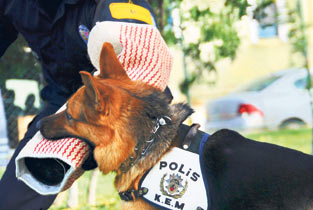
Some future heroes currently reside at the İstanbul Police Department's Bayrampaşa Dog Training Center, where they are trained for patrol and demonstrations only. Those with keener senses of smell who currently work here are later sent to the Gölbaşı Dog Training Center in Ankara, where they receive specialized training.
Although they cannot find bombs yet, all of the 16 dogs at the Bayrampaşa center, their adorable faces and cuteness not withstanding, can turn into very good law enforcement officers excelling in catching purse-snatchers, hooligans and provocateurs at public events.
"We could actually send them off leash and into a crowd during a demonstration," says police officer İbrahim Oruç while giving a tour of the kennel at the Bayrampaşa center. Oruç is the handler of Robin, a 3-year-old German shepherd given to the center by his owner, like most other dogs here. Most dogs are either from irresponsible dog owners who didn't get what they wanted when the puppy grew up, while others are from the Gölbaşı center. The newcomers are put through a number of tests, but how big they are and scary they look is one of the more important criteria. Interestingly, not all the dogs at the center are German shepherds. They currently have rottweilers, dobermans and even a Japanese akita.
Happy dogs, careful fighters
When it is show time, Oruç and officer İsmail Karakoç take Robin, a lively dog eager to take commands but eager for fun and interaction with new people, runs the training course for us, going under cylindrical tubes, running on seesaws and jumping over a series of obstacles, showing us his skills as a good student in the K9 training class. A little white and blue ball that he is crazy about helps him concentrate if he gets distracted and breaks a sit-stay or chooses to go around, rather than jump over, a certain obstacle on the course.
When the officers bring out the attack-training arm pad, this sweet and playful dog turns ferocious and locks his jaws onto the pad with one strong bite. Even then, he does not lose his playfulness entirely and he is quick to let go when told to do so, and comes back immediately on recall. Despite regular attack training, none of the dogs in the center are dangerous. They will not kill the unlucky suspect whose flesh is held between those tightly clenched jaws.
The reason police dogs at the Bayrampaşa center do not turn into unstable killers is that even training to become aggressive has a certain dosage of play involved. "Playfulness is also another very important criterion when we select dogs for the center," explains Karakoç. Every part of the training is centered on play. "For example, in advanced search training, we take a piece of the item we want them to find, and we hide a ball next to it. So they learn to find the item to get to the ball," Karakoç says.
Then officers bring Pascal, a 3-year-old rottweiler, onto the training course. Unlike the curious Robin, who was very welcoming, Pascal does not pay attention to anyone but his handler. Pascal is a special student, as he knows all the K9 curriculum plus some dog dressage. Standing right next to his handler, he watches the handler's feet and does Spanish Walks and extended gaits, both forward and backward, no less gracefully than a prize horse. Later we meet all the pupils of the school, who behave wonderfully and do not embarrass their handlers.
Police dogs in law enforcement
According to information from the National Police Department, Turkey currently has more than 250 police dogs. The Police Department's Dog Training Center Directorate was founded in 1997, ushering in the beginning of the professional training of dogs to assist police in law enforcement. Currently, the Dog Training Center trains dogs and handlers in six areas of canine expertise. All the trainers and handlers are Turkish police officers. Officers who are assigned to canine-backed security posts choose the job voluntarily after an interview.
These dogs have already made significant contributions. In the year 2006, they helped locate 25 percent of all marijuana seized in the country, and 45 percent of all opiate-based narcotics. The police department has plans to increase the number of bomb-sniffing dogs to 100 by the end of 2010 and to increase the number of patrol dogs to 120. The target for narcotic dogs is 77 by the end of 2010. Also according to 2006 figures, dogs discovered more than 20,000 grams of explosive materials and a large number of illegal weapons.
Dogs that assist the police in demonstrations, football games and other public events are primarily treated as deterrents. However, the police department hopes to use these dogs in larger crowded areas, such as parks and beaches, to catch purse-snatchers. But how well do these cop dogs do as riot police? Officer Oruç shares an anecdote: "In the last derby between Beşiktaş and Fenerbahçe in 2006-2007, things got really heated up and all the fans were trying to invade the pitch. There were rows of police around the field, and we -- that is, only two of us with dogs -- kept clear an equally large area as some 50 other officers with great ease while they had to really struggle to keep people off the pitch." Pointing to Robin, he adds, "Some of the fans even shouted at us, 'Come without your dogs if you are real men,' which really does not make sense, because, at the end of the day, he is a member of the police department, too."
Bomb-sniffing dogs are already an important part of Turkey's counterterrorism operations, but the police also have plans to train dogs for special operations, such as hostage situations or detecting large amounts of currency.


