

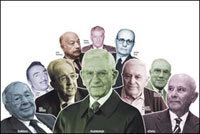
The former secretary-general said the council included some of the most powerful leaders in the country, who came together behind closed doors to talk about Turkey's problems. Other members joined in the debate. Some former force commanders explained that these meetings were very much like a " 5 o'clock tea" meeting. But other members commented that they were not allowed to talk about things spoken there with their wives. For example, former Parliament Speaker Necmettin Karaduman, who referred to the council as a " conversation among friends," also highlighted the commitment to confidentiality.
" This started as weekly meetings at my father's house in 1954. After his death, I became a member. Nowadays we are coming together twice a month. There are politicians as well as soldiers and diplomats in our group. Our group was named by the late President Fahri Korutürk. Since this is an Ottoman name, it gives a sense of secrecy. But I feel sorry when I see what is being written," says Murat Sökmenoğlu, an active member of the council, a former deputy parliament speaker and the son of the late founding president of the Republic of Hatay, Tayfur Sökmen.
But many others assert that this clandestine committee was influential in the formulation of the Feb. 28, 1997, unarmed military intervention that overthrew a coalition government. According to this view, the committee also has links to Ergenekon and to the Western Working Group (BÇG). The BÇG was another clandestine group formed within the army during the Feb. 28 coup that blacklisted various politicians, intellectuals, soldiers and bureaucrats as " dangerous personalities" who were threatening the regime.
But Sökmenoğlu, like most other members of the council, does not accept any link between their " think tank" and the BÇG or Ergenekon. " People who have served the country for several years are coming together and exchanging ideas about national affairs instead of going to bars and night clubs.
What can be wrong in this? Of course, there are soldiers in this group because it was originally founded by commanders that joined the War of Independence. My father was also a commander during the war," Sökmenoğlu says. The council used to prepare reports after their regular meetings and sent these reports to the presidents and prime ministers of the country with two exceptions: President Abdullah Gül and Prime Minister Recep Tayyip Erdoğan.
Mehmet Elkatmış, who headed a parliamentary committee set up in 1996 to investigate a shady network of relationships between unseemly individuals -- such as a police chief and an international criminal -- exposed by an accident, thinks that this discrimination against the current heads of state gives away the council's real intentions. "You claim that you are gathering for the interest of the country. You are producing ideas and developing projects, but you are not sharing these with the general public. You are sending your reports to [former presidents Süleyman] Demirel and [Ahmet Necdet] Sezer and not to the current president. If you are going to keep the results of a brainstorming session secret, why are you doing that? This means that you have different intentions. What I see is this: The council is a civilian extension of the BÇG," Elkatmış told Sunday's Zaman.
Speaking to Sunday's Zaman, Karaduman, who reportedly heads the council meetings, suggested that they are ready to discuss the way their committee is presented in the media but not the principle of the secrecy of the meetings. "I won't bow to any proposal that would suggest a change in the issues that are referred to as secret," he said. "The committee's working procedures are over half a century old."
Although the committee might not be pursuing an illegal agenda, the dealings of some of its members give the sense that it could be a mask for an illegal organization. The fact that retired Gen. Şener Eruygur, an Ergenekon suspect, is a member of the committee and that several other retired generals who are members to the committee were also the masterminds of the Feb. 28 coup does not support the council's supposed innocence. Some of the members of the committee include retired Chief of General Staff Gen. Necdet Üruğ, retired Chief of General Staff Gen. İsmail Hakkı Karadayı, retired Chief of General Staff Gen. Hüseyin Kıvrıkoğlu, former Parliament Speaker Necmettin Karaduman, former Foreign Minister Emre Gönensay, former Foreign Minister İlter Türkmen, retired Land Forces Commander Gen. Atilla Ateş, retired Air Forces Commander Gen. Ahmet Çörekçi, retired Chief of General Staff Gen. Necdet Öztorun, former State Minister Cahit Aral and former State Minister Safa Reisoğlu. The question is whether the decisions made and the reports prepared by the committee had a real impact on political decisions in Turkey. Some point to a letter sent to former President Demirel and then Prime Minister Tansu Çiller in 1995 as proof that the council influences decision-makers in Turkey. Paragraphs of the letter, critics of the council say, were quoted verbatim nearly two years later -- this time in a grim resolution issued by the MGK on Feb. 28, 1997, which ended an elected coalition government. Council member Sökmenoğlu claims he has no knowledge of such a letter.
This could be due to the general nature of such secretive organizations, which are often ambiguous to their own members. The members of the committee are not sure who the chairman of the committee is. Retired Gen. İsmail Hakkı Karadayı thinks the chairman of the committee is Professor Sefa Reisoğlu, but it seems that Karaduman is the acting chairman. Karadayı told the press that the committee elects a new chairman every other year, whereas Karaduman said there is no such procedure.
The ambiguity also continues about the history of the organization. Sökmenoğlu claims that this is only a friends' conversation meeting that started in 1954, but retired Gen. Hüseyin Kıvrıkoğlu equates their current council with the one that was founded in 1851 with the orders of Sultan Abdülmecid in order to prepare books for the newly reformed educational system. Sökmenoğlu claims that the committee has democratic views whereas Karaduman thinks that "a deep state" -- a secret state within legitimate state institutions -- does, should and will exist. Karaduman didn't underestimate the concept that Ergenekon could be the deep state of Turkey. "That is something the judiciary should decide," he said. But he stressed his fear that the recent developments might weaken the deep state. "I hope this is not going to happen," he said. "We will always need it [the deep state]."
Karaduman's ideas about the deep state may be his personal views. Still, why so many honorable citizens of a country, who have served the people and the state at the highest levels of the bureaucracy and politics, come together in secret and don't create an official body is an unanswered question. After the 1967 coup, the Constitution established a senate house and the kind of people who were members of the council were made automatic members of the senate. Trying to utilize the experiences of former high-level diplomats, politicians and soldiers should be welcomed in any political system; but trying to keep such a gathering unofficial while sending reports to the head of the state causes much confusion.
This is similar to the confusion that was created by the news that then Prime Minister Çiller secretly funded the Kadıköy branch of the Atatürkist Thought Association (ADD). Turkey's history is full of clandestine organizations that claim to be serving the interests of the country and the nation secretly. The council is apparently another creation of the long-held elitist motto: "For the people, despite the people!"
ALİ ASLAN KILIÇ ANKARA


