

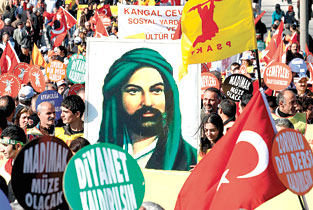
Thousands of demonstrators gathered in the capital's Sıhhiye district to raise their voices against the government. The Alevi groups voiced their demands at the rally, including the abolishment of compulsory religious lessons at public schools; recognition of Alevi prayer houses (cemevis) as places of worship; abolishment of the Prime Ministry's Directorate of Religious Affairs; and the creation of a museum at the site of the Madımak Hotel, where 37 Alevis were murdered 15 years ago. The ruling Justice and Development Party (AK Party) tried to reconcile with the Alevi community in January, when fast-breaking dinner was held in honor of the Alevi holy month of Muharram with the participation of Prime Minister Recep Tayyip Erdoğan. The move divided Alevi organizations, and the AK Party did not follow up on it with any further moves.
Turkey's Alevis, thought to number between 6 and 12 million, stress that they face widespread prejudice and that the state refuses to grant them their religious and cultural rights.
The Council of State ruled in early March that students should not be required to attend religion courses that focus solely on Sunni Islam. The Ministry of Education made slight changes in the curriculum, but this has not satisfied the Alevis, who underline that forcing their children to attend compulsory religion courses violates their individual rights and freedoms. Alevis also argue that the existence of the Directorate of Religious Affairs is in opposition to the principle of secularism, as it amounts to government involvement in religion. They say the directorate imposes religious ideas on Turkish citizens.
The Alevi community also wants the Madımak Hotel in Sivas to be turned into a museum to commemorate the Alevis who were killed there in 1993. During an Alevi Cultural Festival in Sivas the hotel, where many participants were staying, was besieged by an angry mob and subsequently set on fire.
There are divisions within the Alevi community not just with regard to rituals and beliefs, but also in relation to their political struggle. The rally was organized by the Alevi Bektati Federation (ABF), but other Alevi organizations, including the Cem Foundation, opposed it. Foundation Chairman İzzetin Doğan claimed that the people participating in yesterday's rally were Marxists who were cooperating with the pro-Kurdish movement and don't know anything about Alevi beliefs. Supporters of the rally, however, have argued that Doğan's aim is to be the chairman of an Alevi department in the Directorate of Religious Affairs if such a department is ever established.
Meanwhile, State Minister Mustafa Said Yazıcıoğlu said yesterday: "Our Alevi citizens do face various difficulties. They are important to us."
However, when asked what he thought of the Alevi groups' calls for the abolishment of the Directorate of Religious Affairs and of compulsory religion courses in public schools, he said, "We do not give credence to such extreme ideas."
He stressed that the Directorate of Religious Affairs was one of the most important agencies left to the republic by its founder, Mustafa Kemal Atatürk. "Delegations from all over the Islamic world ... come to Turkey every day to study the structure of the directorate. They contemplate how they can model similar institutions based on it. When such is the situation, it is out of the question for us to give any credence to such extreme ideas," he explained.
He said the government was continuing its dialogue with Turkey's Alevi citizens and that there were many commonalities between Alevis and Sunnis. "There is no difference in the love of God and the Prophet and his family. Some circles follow a policy that emphasizes differences. This is not in the interest of our country. We want all of our citizens from all religious groups to live in peace within their own belief systems."
TODAY'S ZAMAN ANKARA


