

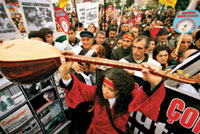
Alevis, who have raised their voices on various occasions to highlight long-standing cultural and religious issues, held a mass rally on Sunday in southern city of Adana to protest the Maraş incidents, in which dozens of people lost their lives in 1978. During the protest, Alevis called on the Turkish nation to stay calm in the face of provocative acts and urged the government to shed light on unsolved murders.
Belonging to a religious group that differs from Sunni Islam and believed to number between 6 million and 12 million, Alevis took to the streets of Adana on the 30th anniversary of the Maraş incidents. The incidents resulted in the deaths of 11 people, mostly Alevis, in the southern Kahramanmaraş province in 1978, after an ultranationalist used a bomb to attack the city's Alevi population.
The bombing was blamed on Alevis, sparking an ultranationalist backlash that resulted in the murder of dozens of Alevis in the city over the course of almost a week. Sunday's protest, held in commemoration of the victims, was attended by representatives and members of several prominent Alevi associations.
'78ers Association Chairman Ruşen Sümbüloğlu said the Maraş killings were part of a bloody scheme paving the way for the Sept. 12, 1980, military coup. " The Maraş incidents along with provocative acts in Malatya, Sivas and Çorum aimed at taking Turkey to a fascist order, which finally prevailed in Turkey for a certain period of time, starting with the Sept. 12 coup," he said. Hasan Fehmi Gümüş, who was appointed interior minister after the Maraş incidents, emphasized that the state failed to shed light on the Maraş incidents. " The state did its best to reveal the dark powers behind the incidents, but the efforts failed to shed full light on the killings," he said. " As a former statesman, my conscience is not at ease with the incidents."
Yesterday's protest came weeks after a " Grand Alevi Rally" in the Turkish capital, in which the Alevi community highlighted long-standing Alevi issues.
Among the demands voiced in the rally were the abolishment of compulsory religious lessons, the recognition of Alevi prayer houses as places of worship, the abolishment of the Prime Ministry's Religious Affairs Directorate and the conversion of the Madımak Hotel, where many Alevis lost their lives in 1993, into a museum.
Fevzi Gümüş, the head of the Pir Sultan Abdal association, one of the leading Alevi groups in Turkey, said the perpetrators of the Maraş killings should be found and punished. " The objective of the incidents was to prepare the ground for the Sept. 12 military coup, to kill Alevis, leftists and democrats in Maraş and to force the survivors to leave their hometown," he said. " What we expect from the state is to find and prosecute the perpetrators of the Maraş incidents and offer an apology to Alevis and all democratic individuals in society."
Ökkeş Şendiller, who witnessed the killings of civilians in his city during the incidents, accused authorities for not taking the necessary measures to prevent the incidents. " They covered up the incidents, and the state declared martial law in our city," he said. " But martial law did not help stop incidents. A document later uncovered suggests that the incidents were planned by the National Intelligence Organization [MİT]. The government should investigate this document."
'Mosque arsons target societal peace'
During Sunday's protest, Alevi leaders also condemned a series of arson attacks against mosques that started earlier this month in İstanbul. They called on the Turkish nation to protect its unity against such provocations.
The mosque arsons began on Dec. 8 in İstanbul's Kartal district and at least 10 mosques were set on fire since then by unidentified perpetrators. The police have set up a special team to track down the attackers. Experts warned arson attacks on mosques aimed to provoke society, but mosque attendees have remained calm.
" Attacks against mosques are disrespect for freedom of belief. Perpetrators of these attacks will be judged by the conscience of the society," said Tekin Özdil, chairman of Alevi Cultural Associations. Özdil noted mosque arsons have hidden motives, such as creating polarization in society.
Alevi Bektaşi Federation President Ali Balkız argued the real target of arson attacks against mosques is to provoke the Sunni population in the society against Alevis, adding current incidents were reminiscent of the Maraş incidents three decades ago.
Representatives from several Alevi associations also expressed concern on Saturday that the fires could be the work of foreign powers trying to turn Alevis and Sunnis in Turkey against each other. " Mosque arsons are the works of people who try to sow seeds of hatred among people. Their aim is to cause polarization in society," said Nasriddin Eskiocak, a prominent Alevi figure.
Eskiocak warned the same power organizing the attacks against mosques may soon press the button for attacks against Alevi places of worship, known as cemevis. He called on public to be careful about such provocative acts, otherwise, he said, the country may be dragged into an atmosphere of civil conflict.
Ali Yeral, the head of the Antakya branch of the Alevi organization World Ehli Beyt Foundation, said the Turkish nation will not allow any power to damage its unity. " I am afraid those setting mosques on fire will soon launch attacks against cemevis. Whenever Turkey tries to stand on its own feet, some power -- either within or out of the country -- shoots it from its very touchy spot. Some are trying to play off Sunnis against Alevis. But we will not allow anyone to damage our unity," he stated.
Many other Alevi leaders and politicians gave messages of unity and peace in a panel held in central Eskişehir province on Saturday. The panel was titled " Turkey United Like a Single Fist with Its Alevis and Sunnis."
İrfan Çetinkaya, head of the Hacıbektaş Veli Anatolian Culture Association, said Turkey was recently going through a hard test. " We witnessed scenarios in the past which polarized the public," he said. " We need to protect our unity to avert similar scenarios."
Hacıbektaş Mayor Ali Rıza Selmanpakoğlu said the mosque arsons were planned and organized by those who don't want Turkey to become a developed country. " They are trying to sow seeds of hatred among people who have lived for years together and in unity like brothers," he said. " Our nation, however, will not fall in such traps."


