

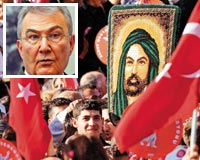
When the names they wanted to see as mayoral candidates from the CHP were left off the party's lists, the Alevi-Bektaşi Associations, Pirsultan Abdal and Hacı Bektaş Associations released written statements asking their members not to vote for the CHP in the elections. The groups made clear that a factor in their withdrawing their support of the CHP has been the CHP's recent controversial initiatives expressing a softer stance toward the Islamic chador and the opening of more Quran schools.
Back-to-back statements from Alevi groups in places including Ankara, İzmir, Çorum, Sivas, Tunceli, Erzurum and Kahramanmaraş both expressed the withdrawal of organizational support for the CHP as well as the resignation from the party of individual members.
Since the establishment of the Turkish Republic, Alevis have been seen as a firm voter base of the CHP, and only once, in 1950, did this demographic lend its support to another party in general elections (to the center-right Democrat Party [DP]). Since then, Alevis have mostly supported leftist parties, but in the Dec. 3, 2002 and July 22, 2007 elections some notable, though small, segments voted for the current ruling Justice and Development Party (AK Party). Even so, no party outside the CHP has been able to boast overwhelming support from Alevi voters.
Groups of Alevis have begun to abandon the CHP weeks ahead of the upcoming local elections. Many Alevi groups have released a statement saying the main factor behind the withdrawal of their support for the CHP has been the party's recent initiatives expressing a softer stance toward the Islamic chador and the opening of more Quran schools |
As in the run-up to any election, in the time before the announcement of candidate lists for the March 29 polls, Alevis were expecting Alevi names to be candidates for spots in districts where many Alevis live, particularly municipal posts. But when once more the CHP failed to meet this expectation, Alevi groups began to leave the party.
First strain was the chador and Quran school initiatives
The staunchly secular CHP's recent initiatives regarding the Islamic chador and the opening of Quran classes played a major part in the growing rift between Alevis and the CHP. When CHP leader Deniz Baykal pinned party badges onto the lapels of women wearing the Islamic chador a few months ago, internal party division and debates began. When the names that some conservative voters -- including women who wear chadors -- supported did not show up on the CHP's lists, some of them removed their CHP badges from their clothing during public announcements and left the party. When this happened, CHP Kocaeli mayoral candidate Sefa Sirmen, in an attempt to woo conservatives, said that if elected he would open Quran schools in every neighborhood, igniting further debate and conflict within the CHP. Baykal threw his support behind Sirmen's words.
The first major, organized reaction to the CHP's new -- but not unanimous -- initiatives came from Alevi Bektaşi Federation President Ali Balkız. Harshly criticizing the chador and Quran course moves, Balkız said that Alevis would blaze their own trail in the March 29 polls. The CHP has disappointed circles expecting respect of secularism from the party, Balkız said, adding, "The initiatives in question are a historical rupture in terms of the CHP."
Balkız said that the concerns of his demographic were set forth in a major rally on Nov. 9 of last year in Ankara and made clear Alevi expectations from the government and political parties were entirely ignored by CHP management. "Alevi voters will decide for themselves whether or not the CHP has represented us. But in the new election period following March 29, Alevis will pave a new path for themselves," he said.
Big splits in İzmir and Ankara
Contradicting an earlier statement expressing support for CHP İzmir mayoral candidate Aziz Kocaoğlu, when the İzmir Alevi Bektaşi and Regional Associations Platform did not see any names they wanted on the CHP's lists for lower posts, it began re-evaluating its support of the party.
Balçova Tuncelians Association President Selman Can said his association was not inclined toward unconditional support for the CHP's candidates in İzmir. Saying that the CHP management had not taken a single request of his group into consideration, Can said his membership had decided to vote without looking at candidates' party affiliations.
Alevis in Çorum have agreed on support of a candidate from the Democratic Left Party (DSP), while Alevis in Konya, Sivas, Erzurum, Kahramanmaraş and Tunceli also formed a platform in support of DSP candidates.
But the biggest battle is in Ankara. Alevis who decided to support CHP Ankara mayoral candidate Murat Karayalçın were unable to convince the CHP to put forward any candidates they favored on the party's lists for the Çankaya, Mamak and Yenimahalle districts, where many Alevis live. Despite Karayalçın expressing time and time again that the winning of Ankara was only possible with the support of smaller municipal polls, CHP Secretary-General Önder Sav refused to accept any of his suggestions for candidates. Karayalçın has emphasized that without gaining the support of personalities favored by the Alevi voter base, such as Seyfi Oktay, Doğan Taşdelen and Servet Ünsal, winning Ankara would be very difficult, but his words went unheeded by CHP officials. Karayalçın has expressed the sentiment that with this attitude from the CHP, the battle was already lost from the outset and said that he would be reconsidering his candidacy. Following the repeated ignoring of Karayalçın's and the Alevi's community's requests, 41 Alevi groups active in Ankara went to CHP headquarters to cancel their party membership and support of the CHP.
Alevis at a crossroads
AK Party Ankara mayoral candidate Melih Gökçek, however, has said that rival Karayalçın actually wants to withdraw from the race because he is doing poorly in the polls, not because he is so upset with the CHP ignoring the requests of the Alevi community. Karayalçın has vehemently denied this claim.
Whatever the case, Karayalçın's campaign is in some trouble, with both internal party bickering and accusations being leveled by the AK Party's Gökçek. Karayalçın's only hope seems to be that Nationalist Movement Party (MHP) Ankara mayoral candidate Mansur Yavaş's campaign will be able to draw votes away from Gökçek.
When on April 18, 1999 Alevis decided not to vote for the CHP, it resulted in the party not entering Parliament. Now, Alevis, whom the CHP has long taken for granted as a base of support, are looking to part ways with the party for good.
Along with the influence of Şişli Mayor Mustafa Sarıgül, who left the CHP and then joined the DSP, Alevis enjoying good relations with the DSP are looking to join up with this party. But Alevi groups are far from agreement on which party can best represent their interests. For this reason, it's unlikely that Alevi support for the CHP will disappear entirely by March 29, but at the same time, it is also highly unlikely that the CHP will be able to expect the Alevi community to vote as a bloc for the party in the future.
Ayşe Gürocak, a representative of Professor İzettin Doğan, a well known name in Alevi circles, says that no political parties should view the Alevi bloc as its backyard and that no Alevi organizations should become extensions of political parties. Speaking with Today's Zaman, Gürocak said: "Alevis have gotten it all wrong until today. Instead of pursuing their constitutional rights, they chased after parties. From now on, I don't think things will be like this because they will support whichever party defends their rights."


