

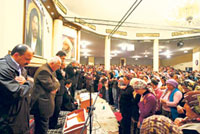
After one of the religious leaders of the cemevi, Ali Yüce Dede, recites prayers as the sun goes down, the crowd breaks their fast. There is no water on the tables, and Alevis try to abstain from it even after breaking their fast during Muharram.
Because they want to empathize with the suffering that Husain, the grandson of Islam's Prophet Muhammad, and his family went through when they were ruthlessly killed in A.D. 680 after being denied access to water on the plains of Karbala beside the Euphrates in modern-day Iraq.
And there are no knives and forks on the table, only spoons.
" We have to know the reason why we are doing this. Muharram means 'illicit [haram] month.' So we must avoid brutal acts such as shedding blood and killing. We do not eat meat either. This is the month that the Prophet's relatives were killed so brutally. We do not engage in entertainment," Yüce Dede told Sunday's Zaman, explaining the logic behind not using knives and forks while eating and why the menu consisted of humble choices such as lentil soup, green peas with potatoes, bulgur pilaf and a yogurt drink called " ayran" in Turkish.
While the Alevis were mourning the killings, much of the world was preparing to say farewell to the year 2008 on Dec. 31 according to the Gregorian calendar, which was indeed the third day of the new year, according to the Muslim lunar (Hijri) calendar.
One of the fast-breakers was 60-year-old Ali Güç, who came to the cemevi with his 7-year-old grandson, Muhammed.
" In the past we would not shave during [the first] 12 days of the month of Muharram," he said. " We would not even take a bath because if you are mourning you stay away from such acts. But we do not adhere to the same practices anymore. It is impossible to do this for 12 days in summer months, especially in the cities where people have jobs to go to. We need to be clean."
Güç cannot help but mention the fact that he is one of the founders of the Yenibosna Cemevi and that they established the place with great difficulty. They started the construction of the simple five-story building in 1995, but could not complete it until 2000.
" I've been living in this area since 1975. It was difficult to say 'I'm an Alevi' in those years."
The offending remarks of one official from the Sunni-dominated Religious Affairs Directorate are particularly memorable for Alevis; the official declared in 2002 that Alevi places of worship are not " cemevis" but " cümbüşevis," places of entertainment.
Apart from distasteful remarks from some officials, Alevis also complain about the distorted perceptions many Sunnis hold about Alevis that they deal with on a daily basis. Güç refers to " mum söndü," which is a non-Alevi idea that during worship ceremonies held in the evenings, Alevis turn off the lights and commit incest and adultery.
" But it's been changing," Güç said. His grandson, who is also fasting, confirmed this. He said he can say in school that he is an Alevi. Grandfather Güç proudly added that Muhammed is a member of the group that performs the sema, the dance aspect of the Alevi cem ritual.
More conscious of the problems of Alevis, the government decided to meet one of their demands: the Turkish Radio and Television Corporation (TRT) has started to air documentaries and religious and cultural programs about Alevism during the first 12 days of Muharram for the first time this year.
" It's a step which has come late. The developments regarding this are in their crawling stage," Yüce Dede said. " Any government would do it no matter what during this time period because Alevis have become more demanding about their basic rights, which includes practicing what they believe in freely."
New year not celebrated during fast of Muharram
Asked if there are any Alevis celebrating the new year on the night of Dec. 31 even though it is a time of mourning, Güç said " No."
" There are atheists who claim to be Alevis as well, but their way of life is not related to the Alevi ways at all. True Alevis do not celebrate the new year when it intersects the fast of Muharram."
After the fast breaking come the rituals at cemevis. The dede talks about the importance of Muharram as the " mersiyedan," the Alevi cantor, recites from lamentation texts. Then Alevis read a Turkish translation of the Quran. Near the end of the ritual, the congregation of men and women -- males on one side of the circular hall, females on the other -- prostrates, stands up and starts to lament hand-in-hand, swaying. Their last prayers go to the spirits of the Karbala martyrs, the martyrs of Turkey's War of Independence and the country's founder, Mustafa Kemal Atatürk.
Atatürk has a special importance for the Alevi community. At cemevis, a giant picture of Atatürk hangs next to a picture of Imam Ali, Husain's father and the fourth caliph. Most Alevis are supporters of the Republican People's Party (CHP), founded by Atatürk. They generally support secularism.
" The Alevi community reacts to religious fundamentalism because they have suffered from it," Yüce Dede said, recalling horrific incidents such as the Kahramanmaraş massacre in 1978, the events in Çorum in 1980 and the infamous fire at the Madımak Hotel in 1993, when several Alevi intellectuals died in a fire set by an angry mob.
Muharram fast and Ashura day
Meaning " 10" in Arabic, Ashura is both the name of the day Husain was martyred and the name of a pudding made on that day. Yüce Dede explains that the 10th day of Muharram is holy according to the Quran and that Sunnis fast on this day, too. After the martyrdom of Husain and his family, it became a mourning period for the Alevis, so named because they are followers of Imam Ali. Alevis fast for 12 days, representing their respect for the 12 imams, or successors of the Prophet Muhammad according to Alevi belief. So symbolism reigns, and Alevis put 12 ingredients into the sweet ashura pudding.
Yüce Dede also explains that the pudding is known to some with a romantic story attached to it. Supposedly when Noah's ark came to rest on Mt. Ağrı in the easternmost part of Turkey, Noah and his wife created the pudding from leftovers to celebrate reaching land. Yüce Dede adds that if ashura is made before the end of the fast, the people making it are not Alevis because they make it without knowing its significance.
For Alevis, ashura symbolizes the sharing of pain. The 12 ingredients are cooked on a fire becoming one and turning into a dessert.
" We are like the grains in the ashura in our sharing of the suffering of the family of the Prophet. The pain is of the Prophet and of Imam Ali. When we share it, it becomes honey to us," they say.
At the end of the Muharram rituals, Yüce Dede reminds the congregation to leave their share for making ashura next Friday for as many as 10,000 people.
Back to Thursday rituals
After the Muharram fast ends, the Alevi community will go back to its usual ritual of cem held each Thursday evening. During the cem, the dede will talk about Alevism, and there will be sema.
And at the cemevi, people take sema classes and classes on English, computers or literacy to help improve their careers.
" A cemevi is not only a place of worship; it is also a place of learning," Yüce Dede said. " We have a library, too."
He added that they serve everyone without asking their belief or ethnicity.
" We have a universal approach. We do not classify people as belonging to a certain community. Prejudices are being broken as more people come here and meet us."
With a half smile on his face, Yüce Dede said he helped students at the library once, and one of them commented that Yüce Dede cannot be an Alevi because he is " so good."
YONCA POYRAZ DOĞAN İSTANBUL


