

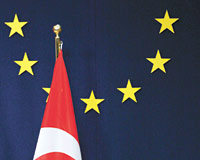
That didn't happen; on the contrary, there has been mutual disappointment on the EU and Turkish side, with the latter blaming the former for dragging its feet in opening more chapters although Ankara has fulfilled all technical requirements.
According to EU Enlargement Commissioner Olli Rehn, the upcoming year will be an important litmus test of whether Turkey is serious about its EU accession goals.
When suspending accession negotiations on eight chapters in 2006 because of Turkey's refusal to open its air and sea ports to traffic from Greek Cyprus, the EU said it would review the situation in 2009.
With the government giving no sign of a change in its policy of not budging on the issue until a permanent resolution is found to the decades-old Cyprus issue, analysts also do not expect any bold steps that would satisfy the EU's expectations, such as a constitutional reform, at least until after the local elections scheduled for March.
The fact that there have been no positive surprises on the EU front, contrary to what was suggested by Babacan in early 2008, doesn't mean a complete absence of positive surprises in Turkey's foreign policy. Actually, there have been several when it comes to Turkey's neighbors on the eastern front.
Taking pains in the Caucasus
The rapprochement with its estranged neighbor Armenia, with whom it has no diplomatic relations, seems to be Turkey's boldest foreign policy initiative. Amidst secret talks between Armenian and Turkish diplomats that reportedly took place in Switzerland in early July, an open call by Armenian President Serzh Sarksyan to Turkey to launch "a fresh start" in relations between the estranged neighbors found a positive response in the Turkish capital.
Eventually, President Abdullah Gül responded positively to Sarksyan's invitation to visit Yerevan to watch a game between the Armenian and Turkish national soccer teams on Sept. 6 in a FIFA World Cup 2010 qualifying match. The visit made Gül the first Turkish president to visit the Armenian capital.
Armenia occupied Nagorno-Karabakh in southwestern Azerbaijan in the early 1990s after a protracted war between Azerbaijan and the Armenians of the mountainous region that began in the late 1980s. In a show of solidarity with Azerbaijan, Turkey severed its diplomatic ties and closed its border with Armenia and announced that Armenian withdrawal from Nagorno-Karabakh was a precondition for normalizing ties.
Gül's visit started a new period of dialogue with Armenia. Later in September, on the sidelines of the UN General Assembly in New York, Babacan had three-way talks with Armenian Foreign Minister Edward Nalbandian and Azerbaijani Foreign Minister Elmar Mammadyarov to discuss the Nagorno-Karabakh dispute.
Preparations for a second such trilateral summit are under way, with Ambassador Ünal Çeviköz, the deputy undersecretary of the Foreign Ministry, having bilateral talks with his Armenian and Azerbaijani counterparts.
Ankara, which has always described the Nagorno-Karabakh conflict as a problem not only for Azerbaijan but also for Turkey and the entire region, acknowledged that resolution of the Nagorno-Karabakh conflict will have a positive impact on Armenian-Turkish relations.
In the meantime, a regional platform for the Caucasus initiated by Turkey has made progress. Deputy foreign ministers of the five member countries of the Caucasus Stability and Cooperation Platform met on the sidelines of a meeting of the Organization for Security and Cooperation in Europe (OSCE) held in Helsinki in early December. It was the first time representatives from the group sat around the same table.
Turkey proposed the platform for conflict resolution in the volatile Caucasus following a brief war between Russia and Georgia over the breakaway region of South Ossetia in August. The platform consists of Russia, Georgia, Turkey, Armenia and Azerbaijan.
Strategic dialogue with Iraq
A shadow cast over bilateral relations between Iraq and Turkey due to the presence of the outlawed Kurdistan Workers' Party (PKK) gradually dispersed during 2008, while Turkey also improved its relations with the regional Kurdish administration following a long hiatus after the US invasion of Iraq.
The United States is cooperating with Turkey by providing intelligence on the PKK in Iraq and allowing Turks to use Iraqi airspace for aerial strikes on PKK targets in the northern part of the country. The Iraqi central administration in Baghdad also condemns PKK attacks but says it has little power in the Kurdish-run north to curb them. A land operation launched in February into northern Iraq against the PKK was followed by a landmark visit by Iraqi President Jalal Talabani.
In July, Prime Minister Recep Tayyip Erdoğan and his Iraqi counterpart, Nouri al-Maliki, during Erdoğan's visit to Baghdad, signed a strategic partnership agreement that commits Turkey and Iraq to cooperation in the political, economic, energy, water, cultural, security and military fields. Gül, meanwhile, is expected to reciprocate Talabani's visit in early 2009.
Foreign Minister Ali Babacan said in October that the Iraqi Kurds could be part of a three-way mechanism if the Baghdad administration agrees. Babacan also said then that Ankara was considering tripartite consultations with the United States and Iraq on ways to stop PKK attacks, as proposed by Talabani in a phone conversation with his Turkish counterpart, Gül, after an Oct. 3 attack by the PKK on a military outpost located near the border that left 17 soldiers dead.
Last month, during a meeting in Baghdad, senior Iraqi, Turkish and US officials formed a joint committee to combat the PKK. The trilateral meeting was also attended by two representatives from the regional Kurdish administration in northern Iraq, including regional Interior Minister Karim Sinjari.
The trilateral meeting and Babacan's remarks followed a meeting in Baghdad between a Foreign Ministry delegation headed by the Turkish special envoy for Iraq, Murat Özçelik, and Iraqi Kurdish leader Massoud Barzani. The meeting broke a taboo in Turkish foreign policy following several years in which Ankara refused to have talks with the Kurdish administration, accusing it of supporting the PKK.
Mediation between Israel, Syria
Ankara's proactive foreign policy in 2008 was not limited to improving bilateral relations with its neighbors. Back in the spring of this year, despite news reports concerning Turkey's mediation between Israel and Syria, Ankara had been tightlipped concerning its efforts. The Turkish capital broke its silence in May only after Israeli and Syrian officials revealed that negotiations were taking place through Turkey.
The talks are focused on the fate of the Golan Heights, a strategic plateau which Israel captured in 1967. Damascus wants the whole territory returned. Israel wants Syria to scale back ties with its main foes -- Iran, Palestinian Hamas and Lebanese Hezbullah.
Yet talks were suspended about three months ago after Israeli Prime Minister Ehud Olmert decided to resign over a corruption scandal. The last round of direct talks between Israel and Syria stalled in 2000 in a dispute over how much of the Golan Heights should go back to Syria.
"We're not seeking to show off. We do not hold unreasonable expectations, either. But Turkey will continue its efforts in a calm manner," a senior government official told Today's Zaman at the time, displaying the Turkish capital's sincere eagerness to contribute to the maintenance of regional peace in the Middle East.
Second summit with Afghanistan, Pakistan
In early December, despite rising regional tension between New Delhi and Islamabad in the aftermath of the Nov. 26 terrorist attacks on multiple locations in Mumbai, Ankara managed to host a trilateral meeting of Turkey, Afghanistan and Pakistan for talks aimed at boosting cooperation between the two neighbors.
The meeting, which gathered President Gül with his Afghan counterpart, Hamid Karzai, and Pakistani counterpart, Asif Ali Zardari, in İstanbul, was actually a follow-up to an earlier trilateral summit in 2007.
In the spring of 2007, Turkey arranged a meeting between Karzai and his then-Pakistani counterpart, Pervez Musharraf, after Kabul accused Islamabad of not doing enough to stop militants from entering Afghanistan from Pakistan.
Ties between Karzai and Zardari's governments have improved, with signs of cooperation among Afghan, Pakistani and foreign troops, especially in dealing with cross-border movements of fighters and equipment.
UN Security Council seat
In October, Ankara's years of unrelenting effort to gain a seat on the UN Security Council bore fruit. While officials hailed Turkey's nonpermanent seat for 2009-2010 as a well-deserved reward for its diplomatic campaign for more influence in regional politics and reforms at home, analysts warned that the role in the UN's main decision-making body will also mean tough choices for Ankara, especially on whether its neighbor Iran should face sanctions over its nuclear program.
The government, which has built good ties with Iran since it first came to power in 2002, advocates a peaceful solution to the row over Iran's nuclear program, but is against nuclear weapons in the Middle East.
Election to the UN's powerful decision-making body has been widely interpreted as a boost for Erdoğan's government, which has lobbied intensely for the position since it declared its candidacy in July 2003.
A more active role will not only give Turkey the power to speak more forcefully on issues of national concern, such as Cyprus, but will also put Ankara in a tight spot over Iran's nuclear program and its relations with the United States. Turkey has also recently secured membership in the International Atomic Energy Agency (IAEA), the main international organization reporting on Tehran's nuclear program.
External anchor and regional influence
Turning back to relations with the EU, which were once described by Babacan as a vital external anchor for Turkey, all of these active and progressive foreign policy achievements by Ankara have been generously lauded by Brussels.
Yet, the EU has also warned that none of these achievements can serve as a substitute for reforms. During a visit to Ankara in November, a European Parliament delegation led by Hannes Swoboda, the vice president of the Socialist Group in the European Parliament, made clear that those bold steps in the foreign policy field could be accepted as "an addition and complementary to reforms."
When reminded of this fact by the visiting delegation during their meeting with Gül, the president conceded, a European Parliament deputy who was at the meeting told Today's Zaman.
"Turkey's strategic importance and regional influence in the East highly stems from its relation with the EU and its potential membership in the bloc," Gül was quoted as telling the delegation in response.
2009 will show everyone whether the government will also concede to this fact in its thorny relationship with Brussels.


