

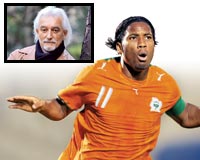
In an interview with Today's Zaman, Alpaslan explained the unknown aspects of African football. He said the three biggest clubs in Turkey are no longer interested in the African market, while European teams have made many previously obscure players from African clubs quite popular. Stressing that Cameroon has become the Brazil of Africa, he said Turkish teams need to have more relations and connections with Cameroon.
While the three biggest clubs transfer players for large sums, Anatolian clubs tend to manage good transfers with competitive prices. What, in your opinion, is the reason for this?
By their definition, they are big clubs. So they feel obliged to transfer famous players with well-known careers. Of course, they intend to attract spectators to games by doing so. But because of this focus, they waste their money. The clubs that do business with the African market can be successful. The best example is Gençlerbirliği. Today Europe's most prestigious clubs are all running some sort of business in the African market. Arsenal has a football school in Côte d'Ivoire. When I was there, Anderlecht had bought a football club in Dualla, the city where I stayed. It would select some good young players between the ages of 16 and 17 and take them to Belgium, where they would be further tested for acceptance on the team. On other hand, the bosses of big Turkish clubs do not want to face pressure from the media or the fans. So they refrain from getting involved in the African market.
Can you talk about your time as a coach in Cameroon?
Cameroon has now become the Brazil of Africa. The world football market is growing. There are numerous players who play in many countries, from Singapore to Cyprus. The original transfer rate for these players does not exceed 50,000 euros. Yet, they soon leap up in the teams they are transferred to. So their prices climb up to several million euros. But in their own countries they do not have sweat suits or cleats; they have to rent them. No money. No facilities. They train on concrete. After every training session, club executives distribute money to players so that they can buy bread. Nevertheless, they have good skills and physical constitutions. They are strong.
You stayed in Africa for two years. You must have seen a number of young and skilled players. Have you ever recommended them to Turkish clubs?
Of course, but they have not paid any heed because the players I suggested were not famous. They were not world-renowned stars. Take the case of Drogba -- when I first arrived in Cameroon, there are was the African Junior Cup. I was watching all the matches. At that time, Drogba was the captain of the Côte d'Ivoire team. Later, I met him in a hotel. He told me that he was playing in the French 3rd League. " Do you want to you play for Galatasaray?" I asked. And he replied, " Why not?" I immediately called Fatih Terim, but I could not reach him.
So I talked to one of his aides. They first asked where he was playing. When I said, " In the French 3rd League," they said: " Prestigious clubs are proposing to sell us elite players. We cannot accept him."
Are there any such examples?
About two-and-a-half years ago, I was chatting with Galatasaray executives and I recommended a Cameroonian player to them. He was 17 at that time. " I strongly recommend him," I said. They told me: " He is too young. How can we transfer him?" They did not want him. That young boy was Alex Song, the cousin of [Rigobert] Song of Trabzonspor, who currently plays for Liverpool.YASIN TUNCER İSTANBUL


