

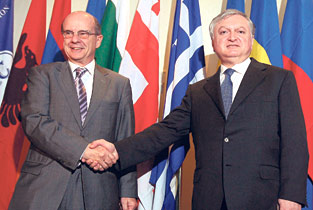
Speaking at a press conference before a meeting with Turkish Foreign Minister Ali Babacan, Edward Nalbandian also said Armenian President Serzh Sarksyan will visit Turkey in October 2009 to watch a game between the national soccer teams of the two countries, reciprocating a similar visit by Turkish President Abdullah Gül in September. "There is active dialogue going on," Nalbandian said at the headquarters of the secretariat of the Organization of the Black Sea Economic Cooperation (BSEC), a regional cooperative organization for which Armenia is currently holding the rotating presidency. "I don't see any serious obstacle for the normalization of ties," he said.
Turkey severed its diplomatic ties with Armenia and closed its border in 1993 in protest against the Armenian occupation of Nagorno-Karabakh in Azerbaijan.
Ankara says the normalization of relations depends on Armenia's withdrawal from Nagorno-Karabakh and an end to Yerevan's support for the Armenian diaspora's efforts to win international recognition for claims that Armenians were subjected to genocide at the hands of the Ottoman Empire. But the visit by President Gül in early September to Yerevan to watch a World Cup qualifying match between Turkey and Armenia's national teams broke the ice between the two countries. Officials have been holding talks on the possible normalization of relations since that historic visit.
In September, on the sidelines of a UN General Assembly meeting in New York, Babacan and Nalbandian had three-way talks with Azerbaijani Foreign Minister Elmar Mammadyarov to discuss the Nagorno-Karabakh dispute.
Describing the ongoing talks as "very positive and sincere," Nalbandian said Armenia and Turkey have a very good opportunity on their hands that needs to be seized. He said by normalization he meant the opening of the border and the restoration of diplomatic relations. "Armenia is ready to establish bilateral relations without any preconditions and we are expecting the same from the Turkish side," Nalbandian said. "This is not a favor. It is in the interest of Turkey to open the border and this is in the interest of Armenia."
The Armenian foreign minister said both sides have made their commitment to the normalization of relations clear during the ongoing negotiations but did not elaborate on possible steps that may be taken. News reports said yesterday Turkey has been planning to accredit its current ambassador to Georgia as an ambassador to Armenia, thus establishing a de facto diplomatic relationship with Yerevan. At the moment, Ankara's messages to Yerevan are first sent to its ambassador in Tbilisi, who hands over this message to the Georgian government for it to be conveyed to the Armenian government. Nalbandian also said it would be a good step for expanding business ties between Turkey and Armenia if Turkish Airlines (THY) were to launch charter flights to Armenia.
THY recently sent unofficial letters to both the Directorate General of Civil Aviation (SHGM) and the Foreign Ministry asking for information regarding charter flights by Armenian national air company Armavia from Yerevan to İstanbul and the Mediterranean coastal city of Antalya, Today's Zaman has learned. THY asked about the arrangements and agreements involving these flights.
In its response, the SHGM said the flights have been taking place with the Foreign Ministry's approval and that permission for Armavia's charter flights to Turkey is renewed every two or three weeks. In the coming days, THY is expected to send another letter to the Foreign Ministry asking whether launching charter flights to Yerevan would "comply with the national interests" of the Turkey. The final decision will be made after receiving the Foreign Ministry's response outlining Ankara's stance on the issue. Nalbandian also outlined his country's priorities for the next six months as rotating term president of the BSEC. Regional cooperation is needed for economic improvement in the region, Nalbandian said.


