

The scale of the carnage, growing daily, has shocked a nation that endures deadly firestorms every few years. There were no quick answers, but officials said panic and the freight-train speed of the firefront probably accounted for the unusually high toll.
Prime Minister Kevin Rudd, visibly upset during a television interview, reflected the country's disgust at the idea that arsonists may have set some of the 400 fires that devastated Victoria state, or helped them jump containment lines.
"What do you say about anyone like that?" Rudd said. "There's no words to describe it, other than it's mass murder."
The country's top law officer, Attorney General Robert McClelland, said that people found to have deliberately set fires could face murder charges. Murder can carry a life sentence.
More than one dozen fires still burned uncontrollably across the state, though conditions were much cooler than on Saturday, which saw record-high heat and winds of up to 60 mph (100 kph).
At least 750 homes were destroyed on Saturday, the Victoria Country Fire Service said. Some 850 square miles (2,200 kilometers) of land were burned out.
Officials said both the tolls of human life and property would almost certainly rise as they reached deeper into the disaster zone, and forecasters said temperatures would rise again later in the week, posing a risk of further flare-ups.
In a sign of the nationwide impact of the tragedy, Parliament suspended its normal sessions Monday to hear condolence speeches by legislators. The voices of many quavered with emotion. Some called it Australia's worst peacetime disaster. More than 4,000 people registered themselves with the Australian Red Cross, which posted lists of names at some 20 emergency relief centers, the agency said. At one such center in Wittlesea, 7 miles (12 kilometers) from Kinglake, survivors scoured the lists looking for missing relatives. Victoria Police Commissioner Christine Nixon said investigators had strong suspicions that at least one of the deadly blazes -- known as the Churchill fire after a ruined town -- was deliberately set. And it could not be ruled out for other fires.
 Elana Watson, 5, reunites with her father in Whittlesea, Australia, on Monday. |
Nixon said the investigation would be long and complex, and cautioned against jumping to conclusions.
Police sealed off Maryville, a town utterly destroyed by another fire, with checkpoints, telling residents who fled and news crews they could not enter because there were still bodies in the streets. Armed police moved through the shattered landscape taking notes, pool news photographs showed.
Evidence of heart-wrenching loss abounded. From the air, the landscape was blackened as far as the eye could see. Entire forests were reduced to leafless, charred trunks, farmland to ashes. The Victoria Country Fire Service said some 850 square miles (2,200 kilometers) were burned out.
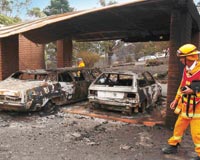
At Kinglake, a body covered by a white sheet lay in a yard where every tree, blade of grass and the ground was blackened. Elsewhere in the town, the burned out hulks of four cars were clustered haphazardly together after an apparent collision. Australian Broadcasting Corp. radio reported a car in a small reservoir, the driver apparently steering there in desperation.
"What we've seen, I think, is that people didn't have enough time, in some cases" Nixon told a news conference. "We're finding (bodies) on the side of roads, in cars that crashed."
John Handmer, a wildfire safety expert at the Royal Melbourne Institute of Technology, said research had shown that people in the path of a blaze must get out early or stay inside until the worst has past.
"Fleeing at the last moment is the worst possible option," he said. "Sadly, this message does not seem to have been sufficiently heeded this weekend with truly awful consequences in Victoria." Even if a house is set ablaze, it will burn more slowly and with less intensity that a wildfire and residents have a better chance of escape, he said.
Extraordinary survival tales were also told.
Jack Barber described how he fled his house in Pheasant Creek near Kinglake with his wife and spent Saturday night on a sports field dodging flames that licked at them from different directions as wind gusts blew around.


