

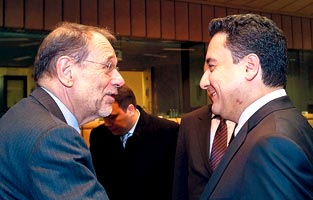
Babacan's remarks came on Sunday while speaking with a group of journalist on board a plane headed to Brussels, where EU foreign ministers met that evening with their counterparts from the Palestinian territories, Egypt, Jordan and Turkey to consider ways to get Arab nations behind new Middle East peace efforts.
Both Turkish leaders and the public reacted harshly to Israel's devastating offensive in the Gaza Strip, which Israel claimed was meant to rout Gaza's Hamas leaders and stop the group's homemade rockets, which have killed around 20 people since 2002. The offensive, which ended with a truce on Jan. 18, killed 1,284 Palestinians -- 894 of them civilians, including 280 children and teenagers -- according to a Pales-tinian human rights group.
The death toll and scale of destruction in Gaza provoked international outrage, but in Israel the war was widely seen as a legitimate response to Hamas' attacks. Thirteen Israelis were also killed, 10 of them soldiers.
|

During and after the offensive, Prime Minister Erdoğan harshly condemned Israel, while constantly emphasizing that Hamas was elected to the Palestinian Legislative Council in 2006 in a landslide victory and urging respect for the will of the Palestinian people. He has criticized world leaders for leaving Hamas out of the peace process. He has also warned that the situation in Gaza could change dramatically if Western countries do not show the appropriate sensitivity toward Hamas.
In a telephone conversation with Palestinian leader Mahmoud Abbas last week, President Gül reiterated the importance Turkey attributes to the solidarity, unity and integrity of Palestinians under the leadership of Abbas.
Comments by certain columnists have suggested that Gül's emphasis on Abbas' leadership was " a balancing act" aimed at calming the reaction of Israel and the US-based Jewish community against Erdoğan's harsh remarks.
" One should consider our president and our prime minister's remarks within a general framework. Different stances are out of the question," Babacan replied when reminded of comments made about Gül and Erdoğan's approaches to the Gaza crisis. " They've been highlighting different aspects of the problem."
Stressing that Ankara has a clear policy vis-à-vis the Gaza issue, the minister voiced uneasiness about misinterpretation of this policy.
" We have criticized the tragedy in Gaza and reacted against Israel's aggressive policy. In our statement on the first day, we condemned 'the operations'," Babacan said, referring to a Foreign Ministry statement released on the same day Israel launched air strikes on Gaza.
" Our prime minister has said many times that anti-Semitism is a crime against humanity. We believe that diplomacy and political dialogue are the most important tools for resolution of the Middle East conflict. Incidents have shown that it is not possible for arms to yield results. Our criticism is directed at the operations," he said.
|

" We want the Palestinian leadership to be strong. We pay heed to a leadership that gets support from the Palestinians. There are difficulties between Palestinians groups," he added, noting that Turkey recognizes Abbas as the head of the Palestinian National Authority, in an apparent reference to the split between Hamas and Abbas' rival Fatah, which lost control of Gaza to Hamas amid fighting in 2007.
" They [Fatah and Hamas] have emotional approaches toward each other. Hamas didn't want to recognize this after Abbas' term in office expired on Jan. 9. All of this has to be overcome," the minister said, suggesting that all parties, including both Israel and Hamas, lost in the attacks on Gaza.
'Cease-fire fragile'
As of Saturday, a Palestinian official close to the Egyptian-sponsored talks said that an unofficial truce between Israel and Hamas, which controls the Gaza Strip, will hold as long as Egyptian mediation continues. Israeli Prime Minister Ehud Olmert ordered a " unilateral" end to a devastating 22-day military attack on the coastal territory on Jan. 17, and Hamas and other Gazan groups called their own halt hours later.
Describing the cease-fire in the region as " fragile," Babacan warned that even a tiniest spark could return the region to the situation before the cease-fire.
" We have to consolidate the cease-fire," he said. Noting that it was not possible to reach a resolution in the region by ignoring Hamas, he urged the international community to work on interim formulas that would include Hamas along with the reconstruction of Gaza.
" Reconciliation between Palestinian groups has to be maintained. For what will be done in Gaza, first of all the political infrastructure needs to be formed. There is a Hamas reality in Gaza. We are not in a position to approve what Hamas has done; however, it is not possible to maintain peace by ignoring Hamas."
Babacan also warned Hamas, saying that the group had to decide whether it would be an armed organization or a political movement.
Meanwhile, he also said that Turkish-Israeli relations might be negatively effected in the short term due to the former's stance on the Gaza crisis; however, he added that he didn't expect any negative effect in the medium and long term. " Israel should understand that our reaction has been fair," he said. MUSTAFA ÜNAL ANKARA / BRUSSELS


