

Both Turkish leaders and the public reacted harshly to the offensive, which Israel said was meant to rout out Gaza's Hamas rulers and stop the group's rockets, which have for years been hitting southern Israeli towns. The offensive, which ended with a truce on Sunday, killed 1,284 Palestinians -- 894 of them civilians, including 280 children and teenagers -- according to a Palestinian rights group. The death toll and scale of destruction in Gaza provoked international outrage, but in Israel the war was widely seen as a legitimate response to Hamas' attacks. Thirteen Israelis were also killed, 10 of them soldiers.
Babacan, speaking in an interview with the TGRT news channel late on Wednesday, said Turkey's harsh reaction to the offensive would not have a negative impact on its bilateral relations with Israel in the medium and long term.
|

On Sunday, the Egyptian resort town of Sharm el-Sheikh hosted an international summit on Gaza that was co-hosted by Egyptian President Hosni Mubarak and French President Nicolas Sarkozy. In addition to Turkish President Abdullah Gül, British Prime Minister Gordon Brown, German Chancellor Angela Merkel, Italian Prime Minister Silvio Berlusconi, Spanish Prime Minister José Luis Rodriguez Zapatero, Czech Prime Minister Mirek Topolanek, UN Secretary-General Ban Ki-moon and Arab League Secretary-General Amr Moussa also participated in the summit.
Olmert invited the leaders of France, Britain, Germany, Italy, Spain and the Czech Republic, which currently holds the rotating European Union presidency, to a dinner in Jerusalem after the summit. The Turkish media have suggested that Olmert did not invite Gül to the dinner as a reaction to Ankara's severe criticism of Israel. Turkey's leaders have labeled the offensive a " crime against humanity."
" Would we have gone had we been invited? I don't think so. Would our president enter that picture in such an environment? I do not presume so. Some time has to pass, and Israel should take concrete steps after that much blood was shed," Babacan said when reminded of the issue. The foreign minister had accompanied Gül during the meeting in Egypt.
The same issue was raised by reporters when Gül arrived in Ankara late on Sunday.
" I don't know who said this," Gül said. " It means that they are not following the incidents closely. Why did the EU countries' leaders go to Jerusalem? I suppose they are saying these kinds of things without knowing [the reason] why. There is a need to know the facts when making comments on these issues. This is true for all of you."
" The US and Israel reached an agreement last week. What was that agreement?" Gül asked reporters, referring to an agreement signed on Friday by Israeli Foreign Minister Tzipi Livni and US Secretary of State Condoleezza Rice.
Recalling that the agreement commits the United States to boosting its cooperation with nations in the region to stop the smuggling of weapons into Gaza and preventing Hamas from re-arming, a key demand of Israel, Gül added: " Some EU countries have said they are ready to lend support to the US on this issue. Israel sees this issue as a matter of security. They went there to support this and display their support for Israel; it has nothing to do with us. Relations between Turkey and Israel continue as usual. Turkey is speaking the truth openly in an extremely honest way."
Babacan will represent Turkey at a meeting called by the European Union to discuss ways to ensure the cease-fire in Gaza holds. Ministers from the 27 EU states will meet ministers from Egypt, Jordan, Turkey and the Palestinian National Authority on Sunday.
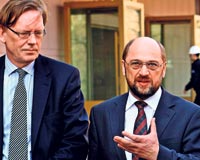
The foreign minister, meanwhile, met yesterday with a European Parliament delegation led by Martin Schulz, the leader of the socialist group in Parliament. No statement was made following the meeting, which was closed to the press.


