

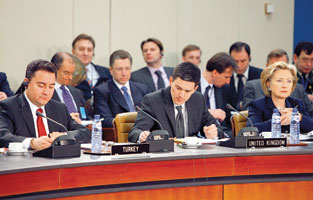
Babacan, speaking at a lunch for ambassadors of EU countries in Ankara, did not point to any specific statement, but said negative remarks coming from European politicians have caused suspicion about the EU's commitment to Turkey's eventual membership. Turkey has been a candidate for joining the EU since 1999 and opened accession talks with the 27-nation bloc in 2005. But progress has been slow since then, amid a loss of reform momentum in Turkey and disputes over Cyprus.
EU foreign ministers said at a meeting in Brussels last week that EU aspirant Turkey had made little progress on the reforms required for entry into the 27-nation bloc over the past year and needed to redouble its efforts. " The [EU] Council is disappointed to note that over the year just passed Turkey has made only limited progress, particularly as regards political reforms," the ministers said. They " hoped that Turkey will now redouble its efforts to implement the measures so long awaited."
The ministers said Turkey should do more to reform its judiciary, fight corruption and torture, guarantee freedom of expression and religion and protect minority rights.
Babacan did not address the criticism raised in last week's meeting but said such debates undermined reform momentum in Turkey. " A weaker trust would mean a weaker EU influence in Turkey," Babacan told the ambassadors.
Analysts say the ruling Justice and Development Party (AK Party) has put the EU agenda on the backburner due to political distractions at home and a lack of eagerness to enlarge the EU among member states after the bloc's costly expansion into Central and Eastern Europe. Powerful states such as Germany and EU president France are not keen on expanding and question the European credentials of the poor and overwhelmingly Muslim country of 70 million people. Turkey is not expected to become a member of the EU for at least another decade.
Babacan dismissed European criticism that Turkey had lost its enthusiasm for reform and vowed that his government was determined to go ahead. " Our government has full determination for reforms. No one should have any doubt about that," he told the ambassadors. " These reforms will sometimes proceed slowly, sometimes fast. But Turkey will sooner or later complete this transformation process that our people well deserves."
The EU is expected to give the go ahead for opening talks on two more chapters at an intergovernmental meeting later this week in Brussels. Babacan said Turkey was ready to open talks on more chapters and criticized certain EU members for blocking talks on certain chapters although technically all preparations are complete.
The foreign minister also said the government had no interest in slowing down the reform process. " On the contrary, we want the reform process to pick up momentum. But it is not in government's hands alone. It is related to the political circumstances Turkey faces and also the EU stance towards Turkey," he said.
The government is pushing for a new reform program to achieve compliance with EU regulations, namely the Third National Program, but critics say it falls short of meeting EU demands for political reforms.
In a report released on Monday, the influential International Crisis Group (ICG) said Turkey was entering a critical year in its relations with the EU and warned the accession process could come to a halt if the downward spiral is not ended.
The EU suspended accession negotiations on eight of 35 chapters in 2006 due to Turkey's refusal to open its ports and airports to traffic from Greek Cyprus and agreed to review the situation once again in 2009.
Babacan said Turkey supported ongoing reunification talks between Turkish and Greek Cypriot leaders in the island. The leaders had their 12th gathering yesterday in Cyprus, discussing the foreign relations of the federal state that will hopefully emerge out of the talks.
Czech presidency to stick to EU tradition in talks with Turkey
The Czech Republic's top official in Brussels said on Tuesday that her country was planning to open European Union accession talks with Turkey on a further two chapters during its upcoming presidency of the EU, sticking to what appears to be a tradition of keeping the number of chapters opened for talks limited to two during each presidency.
The Czech Republic's permanent representative to the EU, Milena Vicenova, said in a speech outlining the priorities of the Czech presidency at the Brussels-based European Policy Centre that her country would follow previous presidencies by opening talks on two chapters out of a total of 35 in the first half of 2009. The Czech Republic is taking over the EU's rotating presidency from the current holder, France, in January.Turkey complains that the EU is going too slowly with the accession process, opening only two chapters every six months. Ankara opened entry talks with the 27-nation bloc in 2005 and it is not expected to become a member for at least a decade.
Vicenova also said the Czechs " strongly support" the EU membership ambitions of states in the western Balkans, saying, " Our country, traditionally, has a deep relationship with countries in this region."
Vicenova added that she hoped that at the end of the six-month presidency " no one will think that we Czechs are euroskeptic."


