

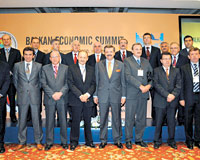
The minister also said the Balkan countries should establish a strong regional cooperation with Turkey. He emphasized that Turkey was an indispensable partner on account of its remarkable role among the G-20 countries, its ongoing EU accession process, its recent election as a non-permanent member of the UN Security Council and its strategic position. " Turkey sees itself as an inseparable part of the Balkans, and peace and stability in the region is our foreign policy goal," he said, stressing that they were the heirs of a shared heritage.
Ekren also said Turkey's election to the UN Security Council would contribute to the solution of the problems of the Balkan countries. " We desire to see the Balkans become a region of prosperity and happiness, not one of poverty and underdevelopment," he noted. He also stressed that they placed utmost importance on becoming fully integrated with the Balkans in both economic and social terms. He underlined that the government expected to make İstanbul a finance center in the region and pave the way for the development of the Balkan countries with easy access to financial resources. He pointed out that the number of tourists from Balkan countries coming to Turkey had increased to 2.8 million in 2007 from 1.4 million in 2000. " With increasing tourism, the people of the region will get to know each other better than before," he added.
Also speaking at the meeting yesterday, Turkish Union of Chambers and Commodity Exchanges (TOBB) President Rifat Hisarcıklıoğlu said it would be for the benefit of both Turkey and the Balkan countries if they were to succeed in reviving the historic Silk Road trade route that once connected Asia and Europe. Turkey, Azerbaijan and Georgia recently decided to launch a joint railway project that would connect the three countries and open an alternative route to Europe. Hisarcıklıoğlu stressed that the trade income to be gained from this route would be enough to greatly enrich the countries in the region. He noted that Turkish entrepreneurs were always ready to invest in Balkan countries, adding that Turkish private sector investments in the Balkans have now reached $1.5 billion.
Meanwhile, Turkey and Montenegro signed a free trade agreement on the sidelines of the economy summit. Foreign Trade Minister Kürşad Tüzmen and Montenegrin Development Minister Branimir Gvozdenovic signed the protocol.


