

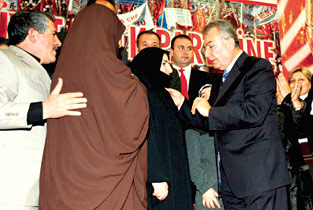
"We are setting off hand-in-and with people who have not come together before. We are setting off with all men and women -- all who cover their heads and who do not,"
stated Baykal as he honored a covered woman with a CHP badge he put on the woman's coat on Sunday. "It is not right to discriminate against people because of what they wear. It is not right to make deductions about them based on their attire," he said.
Baykal's remarks came during a CHP ceremony held in İstanbul in honor of the party's new members, among whom were covered women.
The sudden change in Baykal's tough stance, better known for his opposition to the lifting of a ban on the headscarf in the public sphere, was interpreted by many as a tactic to gain the sympathy of conservative voters in the upcoming local elections, slated for March 2009.
" The leader of the main opposition party is behaving contrary to his party's previous stance. Baykal honoring covered women is a political show to gain popularity among the public. We witnessed similar attempts a few days ago, too," said Ömer Faruk Gergenlioğlu, chairman of the Association of Human Rights and Solidarity for Oppressed Peoples (MAZLUM-DER), an organization known for its protests against the headscarf ban at Turkish universities.
The headscarf was banned on university campuses in the late 1990s through a Constitutional Court ruling on the grounds that to allow it would violate the nation's secular principles because the headscarf was seen as a political and religious symbol.
Gergenlioğlu was referring to a woman in a chador, a dress that covers the body from head to toe but leaves the face exposed. Baykal pinned a CHP badge to the woman's chador in an event held in İstanbul's Eyüp district on Nov. 10 on the occasion of the commemoration of the 70th anniversary of the death of Mustafa Kemal Atatürk, the founder of the Republic of Turkey. " We term Baykal's close contact with covered women as local elections come closer 'election maneuvers.' Baykal should see what the reality is among the public. The public has no problem with the headscarf. It is politicians who have problems," Gergenlioğlu said.
The woman, Güzel Laçin, later spoke to several reporters and said she attended the CHP event just to watch famous singers take the stage. " I was there with my relatives. When they left, I was alone. I suddenly realized that Baykal pinned something to my cloak. I have no ties with the CHP. I never vote for it," Laçin said.
Freedom Association (Özgür-Der) head Hülya Şekerci said political party leaders have a tendency to pretend they respect the values of the public as elections draw nearer. " This is a situation observed ahead of every election. However, the CHP's stance toward the headscarf is very clear. It does not want covered women to enter the public sphere with their scarves," she stated, pointing to an appeal by the CHP to block parliamentary efforts to lift the headscarf ban.
In early February, the governing Justice and Development Party (AK Party), with support from the opposition Nationalist Movement Party (MHP), passed a constitutional amendment package that would lift the decades-old ban on wearing the Islamic headscarf on university campuses. However, upon an appeal by the CHP and its ally, the Democratic Left Party (DSP), the Constitutional Court ruled in early June that Parliament had violated the constitutionally enshrined principle of secularism when it passed amendments to remove the scarf ban and annulled the amendment.
" With local elections looming on the horizon, the CHP is in search of ways to gain the support of the society, a great majority of which is warm to lifting the ban. I believe Baykal's dialogue with covered women is some sort of investment for local elections," Şekerci noted.
This is not the first time the CHP has used the headscarf in its pre-election campaigns. The CHP administration distributed headscarves to female workers in the Yozgat Organized Industrial Zone in Central Anatolia as part of its publicity drive ahead of the July 22, 2007 general elections. Özgür Karslıoğlu, the provincial chairman of the CHP's women's branches in Yozgat, said their objective in that campaign was to prove that the party is not against the wearing of headscarves.
Havva Yılmaz, who came to prominence earlier this year with a statement she released along with her friends advocating freedom for all oppressed individuals in society, agreed and added that the CHP pursues a tactic of pledging freedom for all before elections. " However, they forget these pledges soon after elections. This is something repeated time and again before every election. We've learned through bitter experience that Baykal will never engage in efforts to bring freedom to covered people. His only aspiration is to become successful in elections," she remarked.
Recai Birgül, a DSP deputy, said Baykal's attempts to establish dialogue with covered women may signal a radical change in intra-party politics toward conservatives in Turkey. " Baykal is trying to make up for the CHP's past errors. He was engaged in similar attempts before as well but failed to gain the sympathy of conservatives. As the CHP is far from embracing the values of conservatives, they don't pay much heed to what Baykal is trying to do. For this reason, Baykal's new initiative will end in failure," he stated.


