

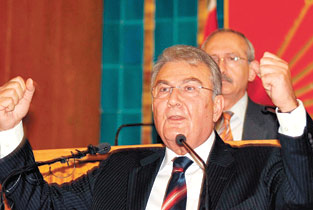
Staunchly secular Baykal surprised all on Sunday during a CHP ceremony with his remarks on headscarves when he said: "It is not right to discriminate against people because of what they wear. It is not right to make deductions about them based on their attire." Baykal also honored covered women, pinning the badge of his party to their clothing. "No one should attempt to sideline others because of their beliefs, ethnic roots or religious sects. We are all brothers and sisters. We are all equal," he stated.
The sudden change in Baykal's stance, who is known for his opposition to lifting a ban on the headscarf in the public sphere, came as a surprise to everyone. Many argued that the CHP leader was using the headscarf as a tactic to gain the support of conservative voters in the upcoming local elections, slated for March 2009. Others welcomed Baykal's move, saying they would be pleased to see the CHP contribute to the solution of the country's problems.
Party members, however, seem divided over Baykal's new stance on the headscarf issue. Some believe Baykal is sincere in his new initiative and aims to make up for the CHP's past mistakes, while others are highly critical of the secularist politician, accusing him of making concessions on the virtues and principles of his party for the sake of gaining greater public support in the local elections.
" To what extent is the message being conveyed by the means of a black chador compatible with the identity of the CHP? ... We are highly concerned about the future of our party because of this [Baykal's] move," stated Haluk Koç, a Samsun deputy of the main opposition party.
Ali Topuz, the deputy chairman of the CHP's parliamentary group, agreed and accused Baykal of deviating from the principles of his party to appeal to conservative voters in the approaching local elections.
" Baykal's was a very wrong step. I believe he did this to garner more votes. His move has caused a disturbance within the party. We will voice our concerns in the CHP meeting next month," he remarked.
Another CHP deputy, Nejla Arat, directed some of the harshest criticism at the CHP for its softened attitude on headscarves, saying that the move led to great disappointment within the party's grass roots. She said this softened stance on headscarves contradicted the CHP's historical line and identity, as she recalled how Mustafa Kemal Atatürk, the nation's founder, struggled against the donning of chadors.
The CHP leader, on the other hand, has responded to criticism that he is aiming to woo conservative voters ahead of local elections. Saying that covered women do not seek to impose their attire on anyone, Baykal said: " These people practice what they believe. They respect and love the nation and honesty; after thinking about all this, they joined us."
Baykal's remarks during his party's parliamentary group meeting on Tuesday came as a contradiction to his party's efforts earlier this year to block amendments lifting the headscarf ban.
In early February, the governing Justice and Development Party (AK Party), with the support of the opposition Nationalist Movement Party (MHP), passed a constitutional amendment package that would lift the decades-old ban on wearing the headscarf on university campuses. However, upon an appeal by the CHP and its ally, the Democratic Left Party (DSP), the Constitutional Court ruled in early June that Parliament had violated the constitutionally enshrined principle of secularism when it passed amendments to remove the scarf ban and annulled the amendment.
Among the supporters of Baykal's new stance on headscarves are CHP İzmir deputy Canan Arıtman, İstanbul deputy Nur Serter, Deputy Secretary-General Mehmet Sevigen and CHP controller Mustafa Özyürek.
" There is nothing in this initiative to be regarded as odd. Anatolian women have contributed greatly to the salvation of our country from enemies and to the foundation of the republic. These were women who covered their hair and who did not," stressed Arıtman.
Serter and Sevigen said it wouldn't be possible for any CHP official to turn their back on women's demands to join their party. " This should not be regarded as a new initiative. These [covered] women come to us and say the CHP is their party. We cannot tell them not to come, saying we don't like their attire," the two noted.
Speaking to NTV yesterday, Özyürek said there was nothing abnormal about his party honoring covered women with party badges as his party is open to all segments of society. " There have been covered women, including ones wearing chadors, working in our election campaigns in Anatolia. Some of these women are even radical CHP supporters."
Political parties suspicious of Baykal's new stance
The change in Baykal's attitude toward covered women raised suspicions among other political parties as well. DSP Deputy Secretary-General Hasan Erçelebi accused Baykal of hypocrisy.
" If you would pin your party's badges on covered women, then why did you apply to the Constitutional Court for the nullification of parliamentary amendments [to remove the headscarf ban at universities]?" he asked Baykal.
Oktay Vural, the chairman of the MHP's parliamentary group, argued that the CHP leader was using the headscarf as a political tool though he had prevented the resolution of the headscarf problem in the past.
Grand Unity Party (BBP) leader Muhsin Yazıcıoğlu, on the other hand, welcomed the change in Baykal's stance. " May it be beneficial for our country. I regard the normalization process within the CHP pretty pleasing as local elections loom on the horizon," he remarked.


