

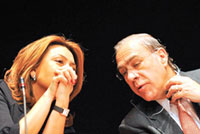
This gloomy atmosphere was reflected in speeches at a panel discussion attended by a number of prominent businessmen yesterday. Turkish Industrialists and Businessmen's Association (TÜSİAD) Chairwoman Arzuhan Doğan Yalçındağ estimated that the growth of the Turkish economy will halt abruptly in the second half of the year and that the country will probably enter a recession in 2009. Organization for Economic Cooperation and Development (OECD) Secretary-General Angel Gurria suggested that 2009 will be very difficult for Turkey as the non-financial sectors will start feeling the adverse effects of the current global crisis much more directly.
Turkish Union of Chambers and Commodity Exchanges (TOBB) Chairman Rifat Hisarcıklıoğlu said the acceleration of Turkey's reform process and its negotiations for accession to the European Union were Turkey's best hope.
Speaking yesterday at the panel discussion on " The Global Economy and Turkey," organized by TÜSİAD, the Foreign Economic Relations Board (DEİK) and the İstanbul Stock Exchange (İMKB), Yalçındağ primarily focused on the prospects of a possible deal between Turkey and the International Monetary Fund (IMF).
" The deal will help clear the ambiguities in the markets, provide a more foreseeable future by delineating the general outlook of economic policies and increase Turkey's credibility in the international markets," she said, adding that the money to be dispatched with the deal will provide a great comfort for Turkey given its $50 billion in external debt.
She said the loan, to be acquired through a standby deal with the IMF, would provide relief for Turkey at a time when global liquidity has almost dried up entirely. Yalçındağ said the only way to slow down the recession process in the economy is to take concrete and purposive measures.
Yalçındağ claimed the global economy was passing through the hardest times it had seen since World War II. The non-financial sectors are now implicated in the crisis, which was originally rooted in the corrupt practices of the developed financial sectors, she argued. For her, even developing economies, which were not expected to be hit by the crisis last year, have been hit by the global fallout. The bankruptcy of Lehman Brothers taught everyone how serious the crisis was, she noted.
She continued: " Today we all know that the speed of the crisis' spread and its magnitude pose real threats to all countries, sectors and companies, regardless of how strong they are or how well they are managed. Moreover, the thesis that developing nations will be spared from the carnage and that the negative effects of the US-originated recession on the global economy will be limited is no longer viable."
As all measures taken by countries individually are destined to be useless, the real solution lies in concentrated efforts in which all developing and developed nations participate, she stressed. " Indeed, one of the biggest lessons learned from this crisis is that developed and developing nations are extremely interconnected and that the economic measures to weather the crisis have to be taken in coordination," she said.
Yalçındağ also dwelled on the effects of the crisis on the Turkish economy. She claimed that the signs of a slowdown in the Turkish economy have been visible since the second half of 2006 but that now it has entered a phase of recession due to the crisis. She cited the industrial output index as an example, saying it dropped 10.3 percent in October compared to the previous year and that further declines wouldn't be surprising. " Under these conditions, it is very likely that the economy's growth rate will turn negative in the second half of the year. According to the estimations of the Organization for Economic Cooperation and Development, Turkey's growth rate in 2009 will be 1.6 percent," she explained.
Hisarcıklıoğlu emphasized the importance of the acceleration of the EU accession process as an anchor for providing stability in the markets. To struggle against the global financial crisis, a more democratic management structure is a must, Hisarcıklıoğlu said, adding that he placed great hope in the summit of leaders of the G20 nations in Spring 2009 and the efforts to be initiated as a result of this summit.
Turkey utilized the 2001 crisis well and restructured its institutions and financial system. It has to continue the reform process without stopping, the TOBB chairman stressed. Similarly, the current crisis, too, will offer the world fresh chances to heal the limping and deficient sides of the global economic system, international financial markets and corporate governance, he said.
Gurria said in his speech after Hisarcıklıoğlu that Turkey is one of the most dynamic countries in the OECD. " Turkey is the only country I have visited three times as a general secretary," he said.
Trillions of dollars have already been lost fighting the global crisis and its effects are now being felt directly by the non-financial sectors, Gurria said, adding that thousands of people are losing their jobs every single day. He estimated that the gross domestic products of OECD member countries would likely continue to decrease, leading to further unemployment. He said the average unemployment rate in OECD countries will climb to 10 percent by 2010 and that nearly 20 million will lose their jobs globally. He stated that the rescue packages launched one after another by some major countries will create temporary relief by decreasing interest rates and introducing flexibility in fiscal policies, but that they will not be sufficient to avert the crisis.
Amidst all these complications, Gurria said, Turkey is well-prepared to cope with the initial adversities raised by the crisis. " If Turkey had entered this crisis without experiencing the reforms and transformation of recent years, it would be in real trouble. You awaited the unexpected in a more prepared manner and this proved very beneficial," he explained. Despite all of these positive remarks, however, Gurria predicted that 2009 will be a very difficult year for Turkey.
He also mentioned the financial relief package the Turkish government is gradually introducing. " Don't be too optimistic about the financial measures under the current conditions. There will be no magical, miraculous results," he said.
Gurria also urged the government to sign a deal with the IMF as soon as possible, saying: " IMF loans are a bridge to normalization. Don't give yourselves unnecessary stress; make use of these loans."


