

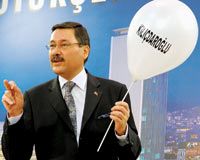
A senior AK Party executive has been heard to say: "Debates which go down a certain road are good. But eventually, Gökçek will be selected again as mayoral candidate." He was certain that Gökçek will win the elections once again as an AK Party candidate. He admitted the negative impact of late announcement of his nomination on Gökçek's psychological wellbeing, but also stressed that the late announcement may have some positive effects on him as well.
It is said that the attitude of the AK Party's top management is chilly toward Gökçek, because of Gökçek's perceived arrogance. Even when Gökçek's behavior was criticized in a recently televised clash to settle an argument over corruption claims between him and the deputy chairman of the Republican People's Party's (CHP) parliamentary group, Kemal Kılıçdaroğlu, it is said that this criticism was because people think he is egotistical. Maybe the delay in announcing his candidacy means an opportunity for Gökçek to engage in some self-reflection. But given that Gökçek has 20 years of experience as a mayor including his time as mayor of Keçiören, his self-confidence is not groundless. Gökçek even launched his own political movement briefly, believing that he had the support of 25 percent of the public. He did not refrain from competing with Prime Minister Recep Tayyip Erdoğan and saw himself as having more chances than Erdoğan.
As the AK Party emerged as a main political contender however, he canceled his pet political project -- resurrecting the Democrat Party (DP) -- and opted for cooperation, rather than competition, with Erdoğan. Those who acknowledge his political genius indicate that he has been preparing for a fourth term as the capital's mayor in a very systematic way. They say that openings for several infrastructure projects originally planned for 2007 were postponed to 2008 as part of the election strategy, stressing the difference that this has made for his election chances. In the same vein, he aggressively prepared his son, Osman Gökçek, for electoral success in Ankara as well.
The most critical maneuver he made in guaranteeing his nomination was that the ensured that the Republican People's Party (CHP) nominated Murat Karayalçın. Gökçek was extremely happy after the CHP announced Karayalçın as its candidate. He has given the following advice to young politicians: "If you want to be successful, then you should decide who your rivals are, and you decide to start or stop fight. You should also be sincere toward voters." Gökçek now admits that he was wrong in accepting Kılıçdaroğlu's challenge.
Ankara is now heatedly debating who will be nominated by the AK Party as the capital's mayor. While recent developments have given rise to suggestions that the names of other candidates have gained weight, many people who have close ties with Erdoğan are sure that Gökçek will be nominated as the party's mayor candidate. They are just giving some time to Gökçek so that he can make his own assessments about "what he has done wrong."
Elections widens gap in the left wing politics
It is obvious that the municipal elections of March 29 will have different meanings for many politicians. This is also acknowledged by political party leaders. Nationalist Movement Party (MHP) leader Devlet Bahçeli was the latest to voice this observation. At a breakfast meeting with Ankara representatives of media organizations, Bahçeli said they want to emerge as an alternative to the government after the elections.
That the prime minister mainly attacked the pro-Kurdish Democratic Society Party (DTP) during the parliamentary session on the new budget. Same concerns have urged Bahçeli to call on CHP leader Deniz Baykal to have a debate on TV. The quick refusal from the CHP leader implies that Baykal has different areas to concentrate on. The most obvious result of the elections will be the widening of the gap between the Democratic Left Party (DSP) and the CHP. The CHP has already transferred several DSP mayors and deputies, which has offended the DSP management. This has had one important but neglected consequence: The CHP will not get any support from the DSP when it petitions the Constitutional Court to cancel any constitutional amendments drafted by the government.
Apologies about the past
A campaign launched by several Turkish intellectuals who issued personal apologies for the events of 1915 has triggered arguments on an unprecedented scale. Erdoğan had harsh criticism for the campaign while President Abdullah Gül stressed the intellectual's freedom of thought, which added fuel to the fire. İzmir CHP deputy Canan Arıtman's words about the ethnic origins of the president's mother were disparaged by many people, with some saying that she was being racist and reactionary. Her reaction to the criticism voiced by the CHP management was perceived by many as paranoid. A politician who talked about how his family had been subjected to atrocities committed by Armenians said: "As part of their responsibility to address every group in society, those intellectuals should have launched an all-embracing campaign. They should also have mentioned the people who suffered in atrocities carried out by Armenians." If Armenian intellectuals lend support to Turkish intellectuals' campaign by launching their own campaign, it seems that the psychological resistance to rapprochement may be overcome.


