

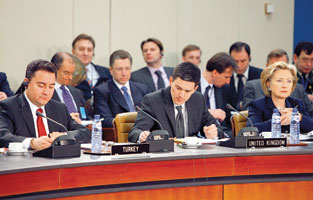
Turkey's proposal to establish a Caucasus Stability and Cooperation Platform came following a brief war between Georgia and Russia in August and aims to gather Turkey, Armenia, Russia, Azerbaijan and Georgia together in a regional platform for discussion and the resolution of conflicts in the troubled Caucasus.
Foreign Minister Ali Babacan, speaking to reporters late on Sunday ahead of his departure for an official visit to Baku, said the function of the Caucasus platform is one of the topics on the agenda for his talks with Azerbaijani Foreign Minister Elmar Mammadyarov.
Regarding the 16th Ministerial Council of the Organization for Security and Cooperation in Europe (OSCE), which he will attend in Helsinki on Thursday and Friday, Babacan said the OSCE's Ministerial Council had a particular importance nowadays due to the current state of affairs in the region.
The first meeting of the Caucasus platform will be held on the sidelines of the meeting in Helsinki and will consist of technical negotiations concerning the platform's goals, principles and mechanisms, Babacan added.
When Ankara first disclosed its proposal for such a platform, some considered the idea to be ill-conceived due to several bilateral conflicts among these five countries. Yet, Azerbaijan, Armenia and Russia welcomed the idea.
The US administration was skeptical about the platform at first, but after Turkish diplomats explained their aims and after a long telephone conversation between Babacan and US Secretary of State Condoleezza Rice, the US administration changed its stance and is now at least neutral toward the initiative, diplomatic sources noted.
Babacan told reporters last month that his Georgian counterpart, Ekaterine Tkeshelashvili, told him during a recent visit to İstanbul that Georgia would be part of the proposed Caucasus platform, despite earlier Georgian statements that the country would not sit at the same table with Russia unless it fully withdrew its troops from Georgia.
A few days after Babacan made these remarks, Russian Deputy Minister of Foreign Affairs Vladimir Titov arrived in the Turkish capital and had talks with Ambassador Ünal Çeviköz, the deputy undersecretary of the Foreign Ministry. Titov and Çeviköz, who is responsible for affairs relating to the Caucasus and Central Asia, assessed progress made so far concerning the Caucasus platform.
Babacan, meanwhile, also said on Sunday that no formal decision had been made regarding a new trilateral meeting between the foreign ministers of Armenia, Azerbaijan and Turkey on the sidelines of the Helsinki meeting.
Noting that the OSCE Minsk Group, which has been mediating between Armenia and Azerbaijan since 1992, would hold a meeting in Helsinki, Babacan said he was planning to have bilateral meetings with Mammadyarov and Armenian Foreign Minister Edward Nalbandian following the OSCE Minsk Group meeting. The three ministers had a joint meeting in September on the sidelines of the UN General Assembly in New York, where they discussed the Nagorno-Karabakh dispute.
Babacan: Nagorno-Karabakh resolution will help Armenia-Turkey relations
Bilateral problems between Azerbaijan and Armenia, Russia and Georgia, and Turkey and Armenia need to be resolved in order to maintain stability in the Caucasus region, Foreign Minister Ali Babacan said yesterday in Baku.
" We cannot leave resolution of problems to the next generation. Turkey peace and stability in the region to be maintained," Babacan told reporters at a joint press conference following his talks with Azerbaijan's Foreign Minister Elmar Mammadyarov, pointing to dialogue as the key to the resolution of regional problems.
The minister declined to give an exact answer to a reporter who asked when Turkey would open its border with Armenia.
" Resolution of the Nagorno-Karabakh conflict will have a positive impact on Armenia-Turkey relations. The Nagorno-Karabakh problem is not only a problem for Azerbaijan, but is also a problem for Turkey and the entire region. We will continue to be there for Azerbaijan as we have been until now," Babacan said.
Turkey severed its diplomatic ties with Armenia and closed its border in 1993 in protest of the Armenian occupation of Nagorno-Karabakh in Azerbaijan. Ankara says the normalization of its relations with Armenia depends on Armenia's withdrawal from Nagorno-Karabakh and an end to Yerevan's support for the Armenian diaspora's efforts to win international recognition for claims that Armenians were subjected to genocide at the hands of the Ottoman Empire. But a visit by President Abdullah Gül to Yerevan in early September to watch a World Cup qualifying match between Turkey and Armenia's national teams broke the ice between the two countries. Officials have had talks on the possible normalization of relations since that historic visit.
While in Baku, Babacan also had talks with Azerbaijan's President İlham Aliyev, and the two pledged that bilateral cooperation would continue between Ankara and Baku in all fields.


