

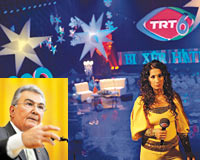
The state-owned Turkish Radio and Television Corporation (TRT) officially launched the new station last Thursday. The public use of Kurdish was prohibited following a 1980 military coup until the year 1991. The dedication of one of TRT's channels to broadcasting in Kurdish was largely welcomed as a move that could strengthen unity between Turks and Kurds.
Baykal, however, became the recipient of harsh criticism when he slammed the launch of TRT 6, which he described as a move that went against the " basic understanding of the state."
" Everybody can air broadcasts in their own language. This is their right. But it is not right to spend the money of the state and 70 million people in line with the ethnic demands of a certain group of our citizens. The duty of the state is not to encourage ethnic identities. Turkey is heading in the wrong direction. They [the government] either know they are doing a very dangerous thing, or don't know what they are doing," he had said.
Mehmet Metiner, a Kurdish intellectual, expressed disappointment with Baykal's statement. He said Kurds in the country were deeply hurt by his discriminatory stance. " Baykal hurt many Kurds with his remarks. He still sees Kurds as 'others' in the society. This is a reflection of his statist and ethnocentric approach. Consciously or not, he made it clear that Kurds are not a fundamental element of this state. However, Kurdish citizens are among the 70 million people he mentioned. The state acted as if Kurds did not exist for years. This is why the Kurdish problem and the Kurdistan Workers' Party [PKK] emerged," Metiner said.
Yıldıray Oğur, a columnist for the Taraf daily, called Baykal's approach to the new Kurdish channel " discriminatory and exclusionist."
" Almost everyone except Baykal has welcomed the new channel. Why didn't Baykal raise his voice while the state was launching many Turkish channels with taxes paid by Kurdish citizens? I advise the main opposition leader to watch TRT 6. I'm sure his ideas will change," he noted.
Gülay Göktürk of the Bugün daily said Baykal's tough stance on the Kurdish channel contradicts the policy pursued by his party a few years ago. " Former CHP Chairman Altan Öymen stressed that a Kurdish channel should be launched by the state in 2000, in one of his visits to the southeastern province of Diyarbakır. The party, however, doesn't remember its past stance toward the channel," she noted.
A similar demand was voiced even by Baykal himself last year when he addressed the nation, saying the state should establish a channel in Kurdish that would serve as a great service to Kurds, including those living in northern Iraq.
Controversy over letters in Kurdish
TRT 6 employs the letters X, W and Q -- which are used in Kurdish but not in Turkish. However, the use of these letters is banned in official correspondence because they are not included in the Turkish alphabet. Those who defy this ban face the risk of being sentenced to up to six months in prison. Public prosecutors are continuously filing lawsuits against those who use these letters in their writings in Kurdish.
Intellectuals believe the controversy over the Kurdish letters will not be too hard to be overcome. Metiner said the problem with letters not included in the Turkish alphabet could be solved in time. " The ban on Kurdish is so irrational. So is the ban on X, W and Q. Turkey needs an improved democracy. I believe Turkey will easily overcome its problem with these letters. A change in legislation may help," he remarked.
Abdurrahman Dilipak, a columnist for the Vakit daily, stressed that these letters are in active use in Turkey. " Isn't it the letter 'W' we write when we want to access a Web site? What will we do with Fox TV or Haber X? Will we shut them down? Or will all of us start using F keyboards instead of the Q one? So, what about the WC? What will we call it, then?" he asked.
'We will restore dignity to Kurdish artists and singers'
Tourism and Culture Minister Ertuğrul Günay said the state will restore dignity to Kurdish artists and singers who suffered in the past just because they wanted to perform in their own language. Günay's remarks came at the inauguration ceremony of the new Kurdish channel on Thursday.
" I remember such Kurdish figures as Ahmet Arif, Ahmet Kaya, Mehmet Uzun and Musa Anter in sorrow. What was the crime of these people? Ahmet Kaya said he wanted to sing in Kurdish and make a Kurdish album. He was attacked and insulted. He had to leave our country. None of these people had different views about the unity of our country. It is not separatism to want to use one's mother tongue. These people were subjected to unjust treatment. Our arms are open to all [Kurdish] artists and singers who had to flee abroad. We will restore their dignity to them," Günay said.
Famous Kurdish singer Şivan Perver, currently residing abroad, said Günay's statement was a very positive, albeit late, move. He noted that he has been called the Pavarotti of the Middle East but is not known in his own country. " I have been in exile for 33 years. I'd like to return to Turkey. There is no legal obstacle preventing me from doing this, but what I want is to make my return serve the cause of democratization and freedom," Perver said.
TRT 6 continues to receive praise
Intellectuals, politicians and academics continue to hail the government for launching a 24-hour channel in Kurdish, saying such a move will help Turkey take steps on its path toward democratization.
" TRT 6 will soon have no rivals when compared with ROJ TV or other Kurdish channels broadcasting in northern Iraq," said Mazhar Bağlı, an academic at Dicle University. Muhsin Kızılka, a writer, said people have so far regarded Kurdish as a political language and that TRT 6 will eliminate this understanding.
Şefik Beyaz, former chairman of the İstanbul Kurdish Institute, said any step taken in the cultural field would facilitate the solution of political matters. Justice and Development Party (AK Party) Muş deputy Medeni Yılmaz stressed that TRT 6 would become one of the milestones of Turkish democracy and help eradicate fears and paranoia in the society.
Rojin hosts talk show on TRT 6
Rojin, a popular Kurdish singer, is hosting a talk show called " Rojinname" on TRT 6. Rojin's show targets female viewers. She said she accepted the invitation to join TRT 6 because she wanted to contribute to the process of normalizing Kurdish. " Kurdish is my language and culture. This is a first for people [in Turkey]," she said. Rojin's show is appreciated by many viewers. Nişan Kaya, a Kurdish housewife, said she was not able to understand shows on Turkish channels. " I like Rojin's show so much. I hope more programs on women and health will be broadcast on TRT 6," she noted. BETÜL AKKAYA DEMİRBAŞ İSTANBUL


