

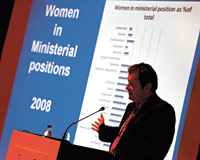
Mahmood A. Ayub, the United Nations resident coordinator in Turkey, said Turkey succeeded in recognizing women's rights 75 years ago and that the country had reaffirmed its commitment to gender equality by ratifying the Convention on the Elimination of All Forms of Discrimination Against Women (CEDAW) in 1986 and becoming a signatory to the UN Millennium Development Goals in 2000.
"Turkey has achieved commendable progress in terms of developing the legal framework that supports the advancement of women, such as the new civil code and reforms undertaken on the penal code. But we all know legislative action alone does not create change. What is also needed is a strong commitment to implementing the laws," Ayub said yesterday at the opening session of the International Conference on Women and Governance in Eastern Europe and Commonwealth of Independent States, held in İstanbul.
Ayub also stated that following the Turkish general election in 2007, the number of women in Parliament doubled from 24 to 50, about 9 percent of the 550 seats.
"This is still undoubtedly an impressive achievement. However, it is still short of the 17 percent target the country has committed itself to in its 2005 millennium development goals report," Ayub added, highlighting that female presentation at the municipal level is only 2 percent in Turkey.
Leyla Coşkun, the deputy director general on the status of women at the Prime Ministry, reiterated that the establishment of gender equality requires social transformation.
"The last step in assuring gender equality is ensuring mental transformation. This corresponds to a long and difficult process of breaking down the established values," she said at the conference.
She also said through a collaboration of civil society institutions and several government agencies, steps have been undertaken to achieve greater gender equality in Turkey and these include establishing a legal basis, setting up and strengthening institutions promoting gender equality, working with the media and increasing coordination among various organizations.
Coşkun added that Turkey has prepared a national action plan for 2008-2013 to improve gender equality in Turkish society.
She also presented a film titled "Equality Empowers" highlighting the unequal treatment of women based on gender.
Participants in the conference will cover mechanisms to promote women's political participation, affirmative action, political party systems, women's branches within political parties and various electoral systems. The presenters come from a variety of countries including Uganda, Lithuania, Russia, the United States, Spain and Kosovo.
The conference, jointly organized by the United Nations Development Program and the Turkish Cooperation and Development Agency (TİKA) is being held at the Hilton Hotel in İstanbul and will end today with the release of the "Regional Report on Women and Governance."
Political participation of women worldwide
•Globally women make up 18.4 % of legislators
•Highest are Nordic countries (41.4 %)
•Lowest are Arab states (9.7 %)
•16 percent of ministerial posts are held by women
•Women heads of state: 4.7 %
•Women heads of government: 4.2 %
•Women heads of parliament: 10.7%
Source: Inter-Parliamentary Union


