

Kardaş made these remarks in relation to the ongoing investigation into the Ergenekon terror organization, under which three former senior generals as well as nine active officers were detained Wednesday together with 18 civilians in the latest operation conducted by police upon a prosecutor's order.
The detentions of retired and active military personnel were made possible through authorization from the Turkish General Staff.
Currently, 86 people are on trial in the Silivri district of İstanbul on charges of either forming or being a member of a terrorist organization, inciting public unrest and encouraging disobedience within the military with the aim of toppling the ruling Justice and Development Party (AK Party).
The indictment that led to the start of the trial in Silivri has revealed the existence of an ultranationalist terror organization determined to overthrow the government.
Under another wave of Ergenekon operations conducted last year, two former generals were put in jail together with some civilians, although their indictment has not been publicized yet. The arrests and detentions of several retired generals and active officers under the Ergenekon investigation represent the first time in Turkish history that such high-level military personnel have been interrogated by civilian prosecutors and judges.
"I do not believe that Ergenekon marks the start of a general cleanup operation within the TSK (Turkish Armed Forces) because the TSK will resist such a move. It is not that easy to change the TSK. But behind the Ergenekon operations may be a consensus with the US to bring the TSK in line with NATO standards, under which interventions into politics through military coups are unacceptable," Kardaş said.
The military of Turkey, a member of NATO, has staged five interventions into the political system since the establishment of the Turkish Republic 85 years ago. These interventions have taken various forms, from direct coups to e-memorandums and "postmodern" coups.
The latest detention of three former generals, some of whom served as senior commanders during the process leading up to the Feb. 28, 1997 postmodern coup, may also hint at a consensus with the US that the military should not be able to stage coups in the future, Kardaş asserted.
Several dailies have made connections between those detained on Wednesday and the Feb. 28 coup that resulted in the overthrow of a democratically elected coalition government under then-Prime Minister Necmettin Erbakan.
Top Turkish commanders held an emergency meeting led by Chief of General Staff Gen. İlker Başbuğ later in the day following the recent detentions. But no statements came out of that meeting. This was followed by an announcement made by the General Staff yesterday and posted on its Web site indicating that Friday's routine scheduled press conference had been cancelled.
This development does not guarantee that the TSK will not come out with a strong statement criticizing the detention of former generals in the coming days, Kardaş noted.
However, considering the strong public reaction against the April 27 e-memorandum in which the General Staff warned the ruling Justice and Development Party (AK Party) against any infringement on Turkey's secular foundations, the top commanders may have been wary of releasing a strong statement after last Tuesday's meeting.
"The TSK saw that the April 27 memo backfired. They would not like it to happen again," another military analyst told Today's Zaman.
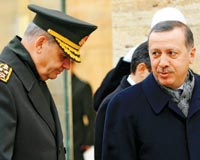
In the meantime, Gen. Başbuğ met with Prime Minister Recep Tayyip Erdoğan at the Prime Ministry and then with President Abdullah Gül at Çankaya palace yesterday afternoon. Interior Minister Beşir Atalay, who attended part of the Erdoğan-Başbuğ meeting, also had a meeting with Gül at Çankaya. The details of what was covered in the meetings are not yet known. In addition, Maj. Gen. Bülent Dağsalı visited İstanbul Police Chief Celalettin Cerrah yesterday. Cerrah said Dağsal came to the İstanbul Police Department to attend a seminar.


