

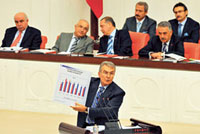
Baykal said that the predicted 4 percent growth was unrealistic and that the opposition was concerned that the government would not be successful in withstanding the crisis. The latest statistics by Turkish Statistics Institute (TurkStat) showed the total increase in the first nine months of 2008 was only 3 percent.
Baykal also said there was abundant liquidity in the global markets just before the emergence of the crisis and that the government failed to make use of these sources. Criticizing the government for starting negotiations with the International Monetary Fund (IMF) to sign a stand-by deal, Baykal said the government was not aware of the facts. "They talk about zero growth in 2009 while they speak with the IMF, but they also say 4 percent of growth expected," he said. "This is contradictory." Finance Minister Kemal Unakıtan said the government should not be blamed for the crisis.
"We are facing a crisis resulting from external factors. Turkey was well prepared against the crisis thanks to effective measures the government has taken," he said.
He asserted that the government has established a disciplined fiscal policy, decreasing the expenditures and increasing incomes with new reforms. " The Turkish economy is now in far better shape than in the 2001 crisis," he stressed.
Unakıtan noted that the world was facing the worst crisis since the Great Depression in 1929 and now it was felt by all countries. " Every single economy is one way or another affected by the adverse effects of the crisis," he said, underlining that Turkey would not be spared from these effects. He said the giant economies were facing recession one by one.
" We saw that the US, Japan and 15 European countries have announced they experienced recession," he said. But there is no recession in Turkey because economic growth continues, though at lower rates than in previous years, Unakıtan continued. He recalled that, according to World Bank, the overall global trade volume would decline by 2.1 percent in 2009.
Unakıtan noted that the precautions governments have taken to withstand the ongoing global financial crisis were not enough to ease the problems in the markets. " The steps that were previously taken proved inefficient in avoiding the negative effects of the crisis from growing, let alone returning things to normal," he said.
He said the government focused on expenditures on education, health and social activities and aimed to minimize the income inequality between the regions. He said the government expected to make the Turkish economy more resistant against the crisis with the new budget. Unakıtan said it was impossible to avert crisis by only introducing new stimulus packages and that the current financial system needed to be changed. He also noted that it was of the utmost importance to maintain confidence in the markets and break uncertainty.
" The gloomy atmosphere should be dispersed," he stressed. " Also, the governments should focus on increasing productivity if they want to continue growing steadily."
He said Turkey will learn lessons from the crisis and make use of the opportunities. " We expect that inflation and the current account deficit will decline in 2009, and we will not face recession," he noted. Unakıtan said the growth rate, which was announced as 0.5 percent on Monday, did not please them. According to the latest figures, the gross domestic product (GDP) growth slowed to a 0.5 percent crawl in the third quarter of 2008 compared with the same period in 2007. " Of course, this is nothing that we are fond of," he said. " However, it is a great success that we have avoided recession."
The minister said the government has maintained steady economic growth in the country and that the average per capita income in Turkey increased to $10,000 in 2008 from $3,517 in 2002. He said the private sector also should take initiatives and seek new chances to increase their incomes.
" We will support new investment projects," he said, noting that the government is expected to increase economic activity in the domestic market. He also said the Turkish market eased to some extent after news that oil prices were declining.
" We import oil and the latest developments are surely for our benefit," he said. He also said decreasing the rate of value-added tax (KDV) was out of the question.
Turkey forecasts a budget deficit of YTL 13.3 billion Turkish liras in 2009. The budget foresees YTL 248.7 billion of revenues and YTL 282.1 billion of expenditures in 2009. According to the budget draft, the primary surplus will stand at YTL 44.1 billion in 2009. The budget sets the growth rate target as 4 percent and year-end inflation target as 7.5 percent in 2009. Parliamentary debates on the budget of 2009 will be held in 14 rounds until Dec. 27.


