

For some Czech companies, the transition to market capitalism has proved to be a difficult and bumpy road as they are still trying to restructure company management. Yet for others, it represents a success story. " We have the products, engineering, industry and technological know-how" said Vaclav Hejtmanek, a consultant with government promotion agency CzechTrade, " but we are challenged in promoting and marketing these products." He said he was optimistic that new Czech graduates from universities at home and abroad would fill the managerial gap.
Martin Michalicek of CKD Elektrotechnika agrees with Hejtmanek about the lack of a sales force needed to promote company products. Speaking to Sunday's Zaman, Michalicek said: " We are technicians and know how to engineer. But now we are allocating our resources to tackle the deficiency in managerial skills in the company." The company, part of the larger CKD Group, which posted $250 million in sales revenue in 2007, supplies electro-technical equipment, primarily semiconductor applications for power generators. It still maintains its production plant in Kolbenova, a region that hosts many empty buildings that were once part of a major industrial zone during the communist regime.
" We are moving towards former communist countries, primarily Russia and Ukraine, where our previous customers live," Michalicek noted. The move makes perfect sense for CKD, as these countries purchased products from the company in the past, and the products will need to be replaced as their lifespan expires. That might be the reason why a Russian woman, Tatiana Kotelnikova, runs the company's marketing department. Kotelnikova told Sunday's Zaman that CKD had opened a branch in Moscow to promote their products.
Struggle to overhaul
Operating in an overhauled factory building, CKD has no room for automated and serialized production. " We are manufacturing customized products per client specifications using our flexible industrial production capacity," Michalicek said, stressing that CKD is a " solution provider" company. According to Michalicek, the CKD electronics division grew 15 percent last year, posting 12 million euros in revenue.
CKD's story is not so different from others who talked to Sunday's Zaman last week. Take the T-CZ company, which specializes in radio communication and radar electronics for both civilian and military use. Otakar Jaros, the deputy director for commercial operations at T-CZ, said they provide most of their products to traditional trading partners in former communist countries. For example, they service older radar equipment of the RP and RL series from the former Tesla Pardubice product line, including upgrades and complete refurbishment.
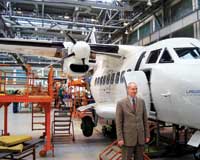
Tomas Mertl of LET Aircraft Industries also considers Russia and other former communist countries very promising markets. Talking to Sunday's Zaman at the company's headquarters in Kunovice, he said the company had supplied over 1,000 small engine aircraft to these markets and that they will need refurbishing, servicing and replacement. LET, mostly known for its small L-410 short-range twin-engine planes, is already scheduled to deliver 15 airplanes for the 2009 order sheet.
Apart from manufacturing companies that represent a strong industrial base in the Czech Republic, there are others who certainly push the bar in innovative and cutting-edge technologies. Ladislav Torcik, who founded Nanotrade in 2004 to manufacture products based on nanotechnology, said his business is flourishing. Stressing that consumer awareness about revolutionary nanotechnology is increasing, Torcik said, " The industry needs to adjust itself to changing market conditions."
Torcik founded the company with partner Jiri Oborny to commercialize nanotechnology to improve the production process and to manufacture advanced high-tech products. Samples displayed in his office in Olomouc include socks impregnated with silver nanoparticles to prevent odor and medical treatment products such as antibacterial gel. Torcik also explained that with additives manufactured using nanotechnology, users can increase fuel efficiency by up to 10 percent and burn energy more cleanly. " If we introduce technology to the structure, we can get permanent results on products like oil and water-resistant surfaces," he said.
Torcik said they act like a bridge between industry and the technology centers of universities. Their work is subsidized by the Czech government, and most of the research and development cost is borne by universities. " The technology is still costly to produce, but we are targeting a small consumer base, like patients who need these products," Torcik noted.
EU membership has been a driving force for the growth of Czech companies, as they were granted access to structural funds. Kovokom, a precision machinery company, has transformed itself from a small workshop to a company of 251 employees in a short period of time. Kamil Bachanek, a project manager at Kovokom, explained that the machinery plant is equipped with automated robotic technology and owns 90 computer numerical control (CNC) machines. It exports 80 percent of its products abroad, supplying 65 percent of its products to the electrical industry and a quarter to the automotive industry.
Kovokom, owned by the Konicek family, started as small workshop in 1990, when the senior Konicek bought machinery from the state for 350 euros. " My father did not expect the company to grow this much," said Vlastimil Konicek, one of three sons who now run Kovokom. The machinery factory operates today in three shops and achieved 20 percent growth last year with a turnover of $27 million.
Most Czech companies are eager to sell their products to foreign markets as the economy is export driven. The government actively supports companies who want to promote their products. " CzechTrade, the government arm for export promotion, is set up with specificity for this objective," said Hejtmanak. The agency helps find new suppliers of goods and services based in the Czech Republic free of charge. It also tries to find foreign partners suitable for long-term industrial cooperation with Czech companies through offices located in a number of countries, including Turkey.
" We were just in İstanbul with 11 Czech companies to join a trade exhibition," said Hejtmanak, who seemed concerned that the global economic slowdown would make his job more difficult than already it was. " We did not get much exposure, but it might have been because of the ongoing crisis," he added. In fact more Czech companies have started to feel the pinch of the crisis. Czech carmaker Skoda Auto, a subsidiary of Germany's Volkswagen AG, said it will not start production in 2009 until Jan. 11 because of falling demand. The Czech car manufacturing sector represents over 120,000 jobs. The Czech Automotive Industry Association expects that up to 10,000 of them may be lost as a result of the financial crisis.
Over the past month 21 companies have announced layoffs, planning to sack 9,000 workers because of declining demand and as a step to prevent the impact of the ongoing crisis, the Hospodarske Noviny daily wrote last week. Sklo Bohemia, a Bohemian crystal maker, went bankrupt a month ago, leaving 1,250 unemployed.
Crisis not felt yet
Not everyone seems concerned about the bad news. Shopping malls are still crowded with Christmas shoppers, and people continue to buy. In fact consumer confidence in the economy grew by 0.7 points last month against a month earlier, in stark contrast to a 6.6 point contraction in business confidence. Hilda Slovodoska, sales manager at energy giant CEZ, said, " We aren't feeling the crisis much yet." She added, however, " There is some bad news we read saying plants have asked workers to stay at home."
International organizations have revised their growth forecasts downward for the Czech Republic, saying they expect contraction this year and next after a record-high 6.6 percent economic growth last year. The International Monetary Fund (IMF) expects the Czech economy to grow by less than 2 percent in 2009, down sharply from a previous forecast of 4 percent. The European Commission predicted a slowdown to 3.6 percent. Despite the bleak numbers, Czech officials do not believe the crisis will shake the economy very hard.
" We rely on collateral and material security rather than the balance sheets of companies," said Karel Simsa, the deputy managing director at government-backed Export Guarantee and Insurance Corporation (EGAP). Natalia Kovacikova, the head of investment development at CzechInvest, also believes the Czech economy will continue its positive growth this year as well as next year. She said the " aftercare" services they provide for foreign companies will help them to remain competitive in the country and keep foreign direct investment (FDI) flowing for the next year.
The government is certainly in good shape financially, and its banking sector shows increased profits in the third quarter, unlike its peers in Western markets. Miloslav Dudek, the head of foreign relations at the Czech Export Bank, attributes this resilience of Czech banks to a lower exposure to subprime mortgages. " Our banks are well capitalized and over liquid," he said. " Loan guarantees represent 75 to 80 percent of all deposits."
ABDULLAH BOZKURT PRAGUE İSTANBUL


