

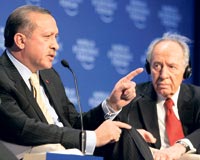
Erdoğan's stance is likely to increase his party's votes, particularly among undecided voters, but the effect will not be great, experts say.
During the WEF summit, Erdoğan harshly criticized Peres for being too aggressive in his speech during a panel discussion on Gaza. Erdoğan also criticized the discussion moderator for not giving him an equal amount of time to address Peres' speech and was not too pleased with the moderator touching him on the shoulder in an effort to prevent him from talking.
Erdoğan walked out of the panel discussion, vowing never to return to Davos again. Recent polls have shown that the Davos incident greatly improved Erdoğan's image and popularity throughout the nation.
Here in Diyarbakır, some voters say they appreciate what Erdoğan did at Davos regarding Gaza, but add that they would like to see the same kind of attitude regarding the Kurdish issue. " It's good what Erdoğan did to Peres but many people died here, too. We have not forgotten what he said when he was in Van," Gaffar Yılmaz, a local shopkeeper, said.
Last summer, during a visit to the eastern city of Van, Erdoğan in his speech called for " one nation, one flag, one motherland and one state," a phrase that offended many Kurds who perceived it to be oblivious to the Kurdish identity. In later remarks, Erdoğan reiterated the call in other cities in the region.
Mazhar Bağlı from Dicle University's sociology department said people in the Southeast are sensitive to problems in the Arab world, particularly about the Palestinian issue. " People here don't only feel a sense of solidarity [with the Arab world] because they are co-religionists, as is the case in western Turkey. Here, people have relatives -- particularly residents of Mardin and Şanlıurfa. They have personal contacts and consider themselves relatives of Arabs," he said.
Bağlı said this sentiment would inevitably reflect at the ballot box during the upcoming municipal elections and that the AK Party's votes could go up; however, he said, resentment remains in the region due to police brutality exhibited toward Kurdish children during demonstrations that took place in the Southeast last year.
He also noted that the pro-Kurdish Democratic Society Party's (DTP) criticism of Erdoğan's Davos showdown might backfire. " They [the DTP] are so negative on every issue that it is actually costing them votes. The voters are always curious to know why the DTP always opposes everything without offering any real constructive criticism," Bağlı said.
Kurdish intellectual Altan Tan underlines that, as is the case throughout Turkey, Erdoğan's attitude will affect the results of local elections and the AK Party will slightly increase its votes, but this will not have a radical effect on the overall outcome of the election in comparison with previous elections. " It can increase its votes by 1 to 2 percent, but that is all because the people here are very disappointed. I think only undecided voters or those who were planning to vote for the Felicity Party [SP] or some other parties can vote for Erdoğan," he said.
Another Diyarbakır intellectual, Şah İsmail Bedirhanoğlu, also agrees that Erdoğan's attitude will affect the votes here, but says the impact will not be seen to the same extent as in the west. " Basically, it will affect the votes in the west. Here, the people will ask questions about what happened here and about lives that were lost here," Bedirhanoğlu said.


