

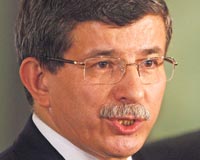
Egyptian President Hosni Mubarak initiated a telephone conversation with Erdoğan on Friday and asked him to send a special envoy to Egypt to join the ongoing cease-fire negotiations between Egypt, the Palestinian Authority and Hamas officials. Upon Mubarak's request, Erdoğan ordered that a delegation led by Davutoğlu and including officials from the Prime Ministry and the Foreign Ministry travel to Egypt.
The delegation was expected to return to Turkey on Sunday night. " However, due to developments in Cairo, the delegation proceeded to Syria's capital," the Anatolia news agency reported, without elaborating and citing anonymous sources in Ankara.
While in Cairo, the delegation had talks with Egyptian Foreign Minister Ahmed Aboul Gheit and Hamas officials. Yesterday in Damascus, they had talks with Syrian Foreign Minister Walid Moallem and officials from Hamas, Anatolia said, without elaborating on whether those officials included Khaled Mashaal, the group's exiled leader living in Damascus.
Reporting from Damascus, Anatolia said the delegation was expected to return to Egypt later in the day, while also noting that there was no statement concerning content of the talks in Syria. Yet, the agency cited senior officials as saying that they have " received positive signals concerning the start of a cease-fire."
In Ankara, the same anonymous sources told Anatolia that the delegation's contacts " have made significant contributions to the cease-fire process and that developments concerning this issue are moving in a positive direction."
Egypt's state news agency MENA said more talks in Cairo with a Hamas delegation on an Egyptian plan for a cease-fire were planned for Monday after " positive" discussions a day earlier. Hamas official Osama Hamdan said some delegates had returned to Damascus for consultations with the group's leadership.
Yesterday, Israeli troops fought gun battles with Hamas fighters, keeping military pressure on the Islamist group while avoiding all-out urban warfare that would complicate ongoing diplomatic efforts to end the Gaza war.
Medical officials said the Palestinian death toll in the offensive Israel began on Dec. 27 had risen past 900 and included many civilians. Israel says 13 Israelis -- three civilians hit by rockets and 10 soldiers -- have died. About 3,600 Palestinians have been wounded.
The health minister in the Hamas-run government in Gaza, Bassem Naeem, told reporters that 42 percent of those killed -- or about 380 -- were women and children. Israel, which says it has killed " hundreds" of fighters, has questioned civilian casualty figures from Gaza but has not offered its own estimate.
Reuters journalists covering sites of attacks and hospital facilities have seen dozens of bodies of women and children.
Israel, which rejected a UN cease-fire resolution last week as unworkable, wants a halt to rocket attacks and measures to stop Hamas from rearming via the tunnels under the Egypt-Gaza border, in an area known as the Philadelphi corridor.
Western and Israeli officials said diplomats were discussing an internationally assisted technical monitoring system to help Egypt stop weapons smuggling and intercept rocket shipments.
Egypt, concerned for its sovereignty, opposes stationing an international force on its side of the frontier.
Hamdan said Hamas was working on a final position on the Egyptian proposal: " The movement has essential concerns over some aspects of this initiative, and there are issues the movement cannot accept," he told Lebanon's al-Manar television.
Mashaal has said the group would not consider a cease-fire until Israel ended its air, sea and ground assault and lifted its blockade of the Gaza Strip.


