

The first indictment against 86 of the suspects claims that the Ergenekon network is behind a series of political assassinations over the past two decades. The victims include a secularist journalist, Uğur Mumcu, long believed to have been assassinated by Islamic extremists in 1993; the head of a business conglomerate, Özdemir Sabancı, who was shot dead by militants of the extreme-left Revolutionary People's Liberation Party/Front (DHKP/C) in his high-security office in 1996; secularist academic Necip Hablemitoğlu, who was also believed to have been killed by Islamic extremists, in 2002; and a 2006 attack on the Council of State that left a senior judge dead.
Alparslan Arslan, found guilty of the Council of State killing, said he attacked the court in protest of an anti-headscarf ruling it had made. But the indictment contains evidence that he was connected with Ergenekon and that his family received large sums of money from unidentified sources after the shooting.
The indictment also says Veli Küçük, believed to be one of the leading members of the network, had threatened Hrant Dink, a Turkish-Armenian journalist slain by a teenager in 2007, before his murder -- a sign that Ergenekon could be behind that murder as well.
The Ergenekon indictment accuses a total of 86 suspects, 41 of whom are currently in custody, of links with the gang. Suspects began appearing in court on Oct. 20 of last year and face accusations that include " membership in an armed terrorist group," " attempting to destroy the government," " inciting people to rebel against the Republic of Turkey" and other similar crimes.
Despite these serious accusations backed by strong evidence, some segments, particularly neo-nationalist groups and the Republican People's Party (CHP), have said the investigation was part of a conspiracy against the opposition. Some have even insisted that there is no such thing as Ergenekon.
But that now seems to be changing, as the undeniable reality and the gigantic extent of the organization is revealed with every new wave of detentions and raids in the investigation.
Every new piece of evidence has refuted another argument by the organization's defenders on the public stage. Every bomb, weapon or item of munitions shows all the more clearly the extent of the danger posed by Ergenekon to civilian democratic life in Turkey. Below is a list of arguments in defense of Ergenekon, with each item accompanied with a fact established during the investigation that refutes the argument.
Argument No. 1: There is no organization: Initially, opponents of Ergenekon were asserting that a widely organized network did not exist but that the case was actually a simple crime gang case.
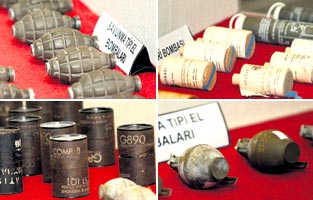
First, hand grenades and assassination weapons as well as blocks of explosives found in houses of various suspects in Ümraniye, Eskişehir and Beykoz, İstanbul, showed that the extent of the organization was much wider than the probe's opponents would like to have others believe. In one of the latest operations into Ergenekon on Jan. 7, 22 hand grenades, five handguns and one Kalashnikov were found in the house of Lt. Col. Mustafa Dönmez, also now under arrest as a suspect. Following the discovery of weapons in Dönmez's house, police teams excavated munitions' caches -- with even anti-tank weapons in the artillery -- from underground in Ankara's Gölbaşı and Yenikent districts. The excavations were based on maps and other documents found in various suspects' homes on Jan. 7. Today, the existence of Ergenekon is something undeniable. The discussion is now on its structure, vastness and purposes.
Argument No. 2: It is an operation against the Turkish Armed Forces: First, noncommissioned officer Oktay Yıldırım, retired Capt. Muzaffer Tekin and retired Major Zekeriya Öztürk were detained, followed in the next wave with the detention of retired Gen. Veli Küçük and retired Col. Fikri Karadağ. Some segments argued that the prosecution was waging a smear campaign against the Turkish Armed Forces (TSK); however, this claim, too, was refuted with the detention of various members of the police force, including former police chief Adil Serdar Saçan, former deputy chairman of the Special Operations Unit İbrahim Şahin and 10 police officers from the Special Operations Unit in the raid on Jan. 7.
Argument No. 3: There are no operations in the East and Southeast: The probe's opponents claim that the investigation would be restricted to the bigger cities of İstanbul and Ankara. But as the operations expanded, nearly 20 people were arrested in Sivas. A death squad of the group was also captured. There were also operations and arrests in Muğla, Hakkari and Van.
Argument No. 4: The case is politically motivated: One of the key allegations the probe's opponents have put forth has been the assertion that the case is a political move to crush the opponents of the ruling Justice and Development Party (AK Party); however, the most recent developments in the case, including the discovery of various arms caches belonging to the group, have refuted this claim. Among political parties, only the CHP says the case is politically motivated. Ergenekon's primary purpose was to prepare the country for a coup d'etat, and it is only natural that the government's opponents would be among their members. Even the fact that an instructor working at a Sivas university was detained in the investigation is enough by itself to refute the thesis that the case is political. Why would the AK Party want to silence an obscure instructor in an Anatolian city?
Argument No. 5: There won't be a new wave of arrests: The same segments claimed that when the chief of general staff visited the prime minister and the president on Jan. 8, there would be no more operations. But there was a new wave of detentions just two days after the meetings, effectively sending one more claim to the trash can.
Argument No. 6: The prosecutor is making this personal: Prosecutor Zekeriya Öz has been in the spotlight more than anybody else during the investigation. Segments trying to water down the case have consistently tried to turn him into a target. There were false stories about him in the printed press. Finally, it was claimed that the prosecutor was turning the case into a personal issue; however, this argument has also been repudiated because it is not Öz but the İstanbul Prosecutor's Office that is conducting the investigation. The statement about the latest operation was made personally by Turan Çolakkadı, the deputy chief prosecutor. Çolakkadı emphasized that the raids were conducted after a search warrant was issued by independent courts in response to a joint demand from four prosecutors.
Argument No. 7: How can you stage a coup with a few guns?: When bombs, long-range rifles and explosives were discovered in houses related to Ergenekon suspects earlier in the investigation, opponents claimed that "you couldn't overthrow a government with a few guns." The Cumhuriyet daily even published the headline, "A coup with a hunters' rifle." But the discoveries of arms caches in the last two operations refuted this argument, as there were anti-tank weapons unearthed from underground; however, the argument actually never held as the organization's purpose was not to takeover the country, but to create chaos in the country to trigger a coup d'etat. Journalist Hrant Dink was killed by a simple revolver, not a tank, but his death caused intense protests, demonstrations and tension. The Council of State shooting in 2006 was also staged with a Glock weapon. In the murders of three Christians in Malatya, a knife was the only weapon used. These three cases are suspected to be related to Ergenekon, and they all caused much tension in the country.
Argument No. 8: The operations are purposefully done in early morning hours: Another criticism was that most of the raids into suspect homes before detentions have so far been organized in the very early morning hours; however, time showed that the prosecution never asked for a certain raid time. In the last two operations, a death squad was captured, apparently ready to assassinate leaders of the Alevi and Armenian communities. The opponents should ask themselves what might have happened if the prosecution had acted later.
Argument No. 9: Law is being trampled underfoot: İstanbul Deputy Chief Prosecutor Turan Çolakkadı explained that every search warrant was issued by independent courts and that none of the prosecutors investigating the case acted individually.
Argument No. 10: There are human rights violations: None of the suspects has complained of maltreatment or rights' violations. To the contrary, every suspect who was released has praised the police and the prosecutor for their politeness.
|

|

|

|

|

|

|

|


