

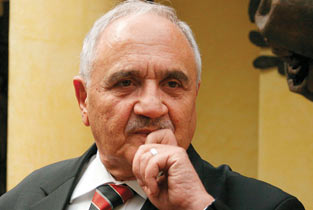
Gönül, who was in Brussels to participate in a European Union defense ministers' meeting, gave a speech at the Turkish Embassy there on the occasion of the anniversary of the death of Mustafa Kemal Atatürk on Nov. 10. In his speech Gönül claimed that if Greeks and Armenians were still living in the country, Turkey would not be the same nation-state it is today. He hinted that Armenia is supporting the outlawed Kurdistan Workers' Party (PKK). Gönül also complained that there was not even one single Muslim among the founders of the İzmir Chamber of Trade. Gönül said on Tuesday that he had been misunderstood.
Gönül was an unofficial candidate for the presidency in 2007. It has been claimed that he had told his close circle that his wife does not wear a headscarf and that his relationship with the military is good so that he could become president. His role in the April 27 e-memorandum issued by the armed forces also led to questions. It was claimed that Gönül knew about the e-memorandum but did not inform the government at that time. On April 27, 2007, the General Staff posted a declaration on its Web site in an attempt to discourage the ruling Justice and Development Party (AK Party) from nominating Abdullah Gül, minister of foreign affairs at the time, for the presidency. The government decided to hold early elections after the e-memorandum.
Gönül, who is a former governor, claimed that reform efforts during the last years of the Ottoman Empire were ineffective and were unable to " save the country." He suggested that the " success" of the republic lies in the nation-building process:
" If there were Greeks in the Aegean and Armenians in most places in Turkey today, would it be the same nation-state? I don't know with which words I can explain the importance of the population exchange, but if you look at the former state of affairs, its importance will become very clear," Gönül said.
The Lausanne Treaty signed in 1924 called for a population exchange between the Greek Orthodox citizens of the young Turkish Republic and the Muslim citizens of Greece, which resulted in the displacement of approximately 2 million people.
The Armenian population that was in Turkey before the establishment of Turkish Republic was forced to emigrate in 1915, and the conditions of this expulsion are the basis of Armenian claims of genocide.
In the same speech, Gönül hinted that Armenians are supporting the PKK. " We cannot deny the contribution of those who consider themselves the victims of this nation-building, especially the forced emigration, to the struggle in the southeastern Anatolia," he said.
He added that in those days Ankara was composed of four neighborhoods -- Armenian, Jewish, Greek and Muslim -- and claimed that after the nation-building process, it was possible to establish a national bourgeoisie.
Soli Özel from Istanbul Bilgi University underlined that Gönül's remarks about nation-building are correct from a historical point of view but are very unfortunate because they show that Gönül is not aware of the loss Turkey has experienced due to the homogenization of the population. Özel underlined that Gönül's hints about the Kurdish question and forced Armenian emigration clearly show that the defense minister does not understand the Kurdish question and the effect of failed policies towards it.
Professor Baskın Oran said Gönül's remarks are nonsense in all of their dimensions.
" The expulsion of Greeks and Armenians led a delay of industrialization for at least 50 years. There is no such thing as a national bourgeoisie; naturally, the bourgeoisie are cooperating internationally," Oran said.
According to Oran, Gönül's remarks are also connected to the positions of Prime Minister Recep Tayyip Erdoğan. Referring to recent claims that the AK Party is losing its Kurdish supporters due to Erdoğan's remarks on the Kurdish issue, Oran said, " The others in the party are just following him."
Professor Doğu Ergil from Ankara University, a Today's Zaman columnist, said Gönül's remarks are very unfortunate and that society is under threat. " We are all threatened by discriminatory perspectives that support ethnic cleansing," Ergil pointed out.
Öztürk Türkdoğan, the chairman of the Human Rights Association (İHD), said Gönül's remarks are a reflection of a very flawed understanding of the nation-state. " The existence of different ethnicities in a country does not mean a unitary state is impossible. Gönül's remarks reflect the ideas of World War II," he said.


