

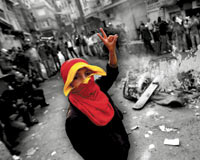
Minors can be sentenced to several years in prison under various articles of Turkey's Anti-Terrorism Law, including "spreading the cause of a terrorist organization," "committing a crime on behalf of a terrorist organization without holding membership," "resisting police dispersion attempts with weapons or instruments" and "vandalizing public property."
"Punishing young children with long prison terms serves no purpose other than escalating terror. I don't think the Republic of Turkey can solve the terrorism problem as long as it approaches it with harsh sentences," said Ömer Faruk Gergenlioğlu, chairman of the Association of Human Rights and Solidarity for Oppressed Peoples (MAZLUM-DER).
The Higher Criminal Court for Juveniles will hear the Diyarbakır case in a few weeks. Many of the minors are under arrest pending trial.
Gergenlioğlu stressed that the real reason behind the illegal demonstrations being attended by Kurdish citizens is not terror, as is believed by state and government officials. "The real reason is the Kurdish question. The problem of terror in Turkey will not be solved unless the Kurdish question is solved," he noted.
Turkey's Kurdish question has existed ever since the founding of the Turkish Republic, but has turned violent in the last 25 years, with the terrorist Kurdistan Workers' Party (PKK) launching an armed campaign against Turkish civilians and security forces for autonomy in Turkey's predominantly Kurdish Southeast.
The Radikal daily wrote in its lead story on Thursday that more than 100 children have faced the risk of being sentenced to more than 20 years in prison for participating in illegal demonstrations or rallies since last October.
Demonstrations reached their peak in early November as Prime Minister Recep Tayyip Erdoğan traveled to Turkey's eastern and southeastern regions, with pro-Kurdish Democratic Society Party (DTP) supporters protesting the visit violently in clashes with the police, throwing stones and burning vehicles. Demonstrators were protesting against the alleged mistreatment of jailed PKK leader Abdullah Öcalan, who is being held on the prison island of İmralı, where he is the sole inmate. The allegations were put forward by Öcalan's lawyers and no evidence was provided.
Last month DTP leader Ahmet Türk also slammed prosecutors asking for long prison terms for children, saying the ruling Justice and Development Party (AK Party) cannot win the people back "by turning the whole country into a prison."
"What kind of a mindset is this? Is this the way you embrace the public? These children grow up under the shadow of guns and tanks," he said, also criticizing a recent verdict by the Supreme Court of Appeals punishing people who had participated in demonstrations held in support of the PKK as if they were PKK members.
"This verdict means that all individuals participating in democratic demonstrations will be punished on charges of membership in a terrorist organization. It seems that the government will soon set up courts in the streets and judge millions of people," he remarked.
Öztürk Türkdoğan, chairman of the Human Rights Association (İHD), said punishing children with harsh sentences would not deter them from participating in other illegal demonstrations. "On the contrary, such sentences will have an adverse influence on youngsters. Punishing children with prison terms should be the last resort," he argued.
Stressing that children in Turkey's eastern and southeastern regions grow up in the midst of conflicts and clashes, Türkdoğan noted that youngsters participate in illegal demonstrations due either to the encouragement of their elders or of their own will.
"How can anyone believe that long prison terms will deter these children from attending other rallies? How old are they? Are they old enough to make a distinction between good and bad?" he asked.
Türkdoğan said the behaviors the children display in demonstrations are closely related to the attitude the police and security forces take toward them.
"There was a demonstration in Mersin in October. Police distributed balls and toys to children to prevent them from participating in the tension that erupted between security forces and demonstrators. You see, if the police behave toward the children in a positive manner, the children do the same," he explained.
Türkdoğan also noted that there must be a directly proportional relationship between the crime and the punishment, adding that a child accused of throwing a stone at security forces should not be sentenced to prison as though he committed murder.
"I don't think these children will end up being good citizens under unfavorable prison conditions. We all know about the conditions inmates are faced with in prisons. How can anyone expect to prevent these youngsters from joining a terrorist organization by sending them to prisons?" he added.
Seda Akço, from the İstanbul-based Child Abuse Prevention Platform, said children in the East and Southeast are caught in an unjust dilemma. "On the one hand, there is a terrorist organization and, on the other, the police. It is known by everyone under what conditions these children are dragged into clashes with the police. We need to prevent them from participating in clashes between demonstrators and security forces. Punishing them severely is no solution," she noted.


