

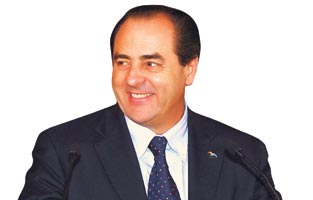
Antonio Di Pietro, who was armed with extraordinary powers in the Clean Hands operation, which cleansed Italy's political system of illegal activity in the early 1990s, told Today's Zaman that it would be a "crucial mistake" if the Turkish judicial system was deprived of the right to record phone conversations under certain circumstances.
"This move would be equal to giving Ferraris to criminals and leaving the prosecutors with horse carts," he said, adding that criminals follow technical developments quite well and develop new techniques to eliminate proof of guilt. In that environment, he said, prosecutors need to be able to use technology to track criminals.
The Clean Hands operation in Italy led to the demise of the so-called "First Republic" and resulted in the closure of many political parties and the prosecution of a number of politicians, along with industry leaders, some of whom committed suicide after their crimes were exposed.
One prominent figure exposed in the operation was then-Prime Minister Bettino Craxi.
In Turkey, the question of whether legal wiretapping can be used as evidence in criminal cases has come onto the agenda mainly because of the investigation into Ergenekon -- a criminal network with links to the state, including the military and judiciary as well as the media, accused of a number of political murders and attacks designed to trigger an eventual military takeover.
The Constitutional Court is in the process of reviewing the constitutionality of Article 135 of the Code on Criminal Procedure (CMK), which allows legal wiretapping, over concerns that it may contradict the Constitution's provisions for " freedom of communication" and " the right to privacy."
Article 135 came into effect on June 1, 2005 and makes provisions for the interception of communications of an individual if he or she is suspected of committing a crime.
During an investigation, if there is a strong suspicion that a crime has been committed and there are no other means of collecting evidence, or in situations where a delay would be dangerous, the telecommunications of a suspect may be intercepted, monitored or recorded upon the request of a prosecutor and the approval of a judge. In such cases, the public prosecutor immediately submits this request to the judge for approval and the judge decides on the matter within 24 hours.
Currently the interception, monitoring and recording of communications is done through a single department working within the Telecommunications Board, which answers directly to the president of the board.
Di Pietro noted that the limits of legal wiretapping should be made clear and that the transcripts of such recordings should not be made public, especially when they relate to a suspect's private life.
" Private life should be respected, but prosecutors should never be transformed into surgeons without tools," he added, likening prosecutors to " community doctors."
" Investigations start with a clue, just like the process of diagnosing illnesses. Prosecutors try to diagnose and treat the ills of the society. But politicians don't want to be treated because they are afraid of being eliminated. They even start complaining about the prosecutors," he said, emphasizing that intelligence services should be overseen by the parliament in democratic countries. SELÇUK GÜLTAŞLI BRUSSELS


