

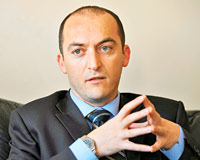
"To act with the assumption that the tragedies in the Balkans will be repeated is unjust and immoral," Sejdiu explains. "We should start a new beginning for a new generation."
Sejdiu, who spent his childhood in Kosovo during the war, has a master's degree in human rights and democracy. He is in the final stages of completing his Ph.D. in international relations at Bilkent University.
When asked about his childhood during the war, Sejdiu says that because he grew up in extraordinary conditions, it is impossible to forget what happened. But he says his generation is responsible for starting anew.
"We are in a position to do our utmost for a new beginning. The reasons behind these tragedies were very complex and multi-dimensional," he says. "We cannot forget the past, but this should not mean that we should let the past to influence our vision. Try to make a new beginning in the direction of a stable and prosperous region is our responsibility for our country, our region, our family and ourselves. I don't want my children to have the same experience that I had during the last two decades."
Sejdiu was working as a lecturer at the Department of International Law at the University of Priština. He worked as an expert for several international and local projects related to the public sector as well as the civil society sector in the Republic of Kosovo.
On April 8, Sejdiu was appointed as principal political adviser to the Kosovar minister of foreign affairs. He admits that he never dreamed of being appointed as a diplomat -- not because he does not want to but because it never occurred to him:
"Survival was the biggest concern -- survival of my country, my nation, family, society. ... It would have been quite difficult to make these kinds of predictions even a few years ago. But here we are," he says, adding that he is enthusiastic to finish the logistical preparations for the embassy as soon as possible. He says Kosovo's public is grateful to the Turkish government, which helped solve a lot of the logistical problems.
Sejdiu is familiar with Ankara. He obtained his second master's degree in international relations from Bilkent University. He says that Ankara was important for his intellectual formation and the he was happy about being appointed here. He feels privileged for being one of his country's first diplomats, but he says this situation brings huge responsibility, too.
"Kosovo is opening its embassies now and creating its own diplomatic network. It is honor for us to be an important part of this historical, irreversible moment. We are privileged. To be appointed to Ankara makes my feeling of privilege even greater," he says. "We have a great responsibility at the same time. Although we are a very young country, we have a cultural, social tradition that we will reflect in our diplomacy. Our vision is to create a democratic, prosperous and integrated region and to be a respected global actor. We are aiming to build strong relations with other countries on the basis of this vision."
He also feels privileged that his country already has excellent relations with Turkey, which is a "strategic partner for Kosovo," Sejdiu says, adding that their aim is to boost the relations.
The Republic of Kosovo declared its independence in February and is recognized by more than 50 countries, including Turkey, but because of objections from the Russian Federation, it did not apply to the UN.
When he was an adviser to his country's foreign minister, Sejdiu was in touch with the diplomats of countries that did not yet recognize Kosovo as a republic. But in Ankara, as soon as the logistical facilities including the embassy are finished, he will start to "transmit" his country's ideas about the future of the region.
"Kosovo is undergoing the international recognition process. Some countries have already done it, and the others will do so when the time comes. We have to transmit our views to countries that have not recognized us yet. Kosovo is an irreversible reality, and its recognition is crucial to starting a new era in the region," he emphasizes, adding that they were surprised that Egypt refused to grant visas to the Kosovo delegation that plans to participate in the meeting of the Organization of the Islamic Countries (OIC).
"The people of Kosovo expect the countries of the OIC to be part of the supportive and prosperous region," he says. "I cannot deny the fact that this move surprised the people of Kosovo because we had support from many states of the OIC, especially from Arab countries, during the war. We hope that more member states of the OIC will recognize Kosovo."


