

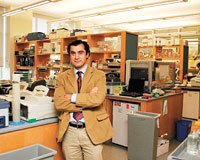
The international team led by Dr. Günel scanned the genomes of more than 2,000 people suffering intracranial aneurysms along with 8,000 healthy subjects. The subjects were from hospitals in Finland, the Netherlands and Japan, and the results were similar in all groups, indicating the variations increase risk among diverse human populations.
" Even though we have made significant strides in treating unruptured aneurysms, until now we have not had an effective means of identifying the majority of individuals at risk of developing this deadly problem," said Günel. " These genetic findings provide a starting point for changing that equation." The study can be found online in the journal Nature Genetics.
But how did the 15-year-long study that led to the Nature Genetics article begin? Günel said that when he was a young assistant in 1991, he chose to specialize in vascular disorders, a decision greatly influenced by Gazi Yaşargül, a professor of medicine whom Günel referred to as " the teacher of us all." Günel explained: " Professor Yaşargil made a revolution in aneurysm disorders. We can treat these diseases now thanks to Yaşargil." As Günel put it, although it is possible to treat unruptured aneurysms, 30-40 percent of patients die after the first hemorrhage caused by a rupture. Those who survive can rarely go back to their old healthy lives.
When the team started collecting their first samples for the research in 1994, medical technology was not as advanced as it is today, Günel remembers. Technology to sort out genes that have only a minor influence on diseases became available to the service of medical science only two years ago, giving the Yale researchers the opportunity to accelerate the study's pace.
The most significant success of the team was its ability to collect over 15,000 samples from various countries around the world, a number expected to grow to 22,000 in the near future.
" This is the product of teamwork," Günel said.
He said their discovery was of a quality that would change the scope of brain surgery. " What we have done for now is to find the genes. The next stage is really understanding the biology of these genes. The last stage is finding treatment methods," he said, calculating that it would take at least another 30 years if the two stages ahead take as long as the initial research did.
So what will the discovery of these three genes contribute to medicine? In response to this, Dr. Günel asked the questions: " Why do people get old? What are the causes of those diseases that occur with age?" He noted that aneurysms, similar to heart disease and type II diabetes, are diseases that emerge later in life, which you don't see in children and youth. The major theory is aging is linked to a decrease in both the number and capacity of stem cells. " These three genes cause people to get older earlier. While you would see aneurysm disease in people of ages 60-70, if you have one of the three bad genes, you get it when you are 50. If you have all three bad, then you get it at 40. If you have all three and smoke and have hypertension on top of that, you become an aneurysm patient at 35," Günel said, noting that these factors are not isolated from each other, but rather, act as triggers.
Günel said they still need time to understand and correctly read the results of aneurysm tests.
The study required a great deal of funding. As Günel puts it, they set out looking for a single letter among 3 billion letters in the human genome. " When we started, the cost was $500 per person. Today, it has gone down to $270. We have done about 11,000 samples; we can do the math from there. Of course that's only for genetic coupling, add that the human costs and time costs. We are lucky that the result was worth the cost," Günel said. The study was funded by Yale University, the National Institutes of Health (NIH) and the Howard Hughes Medical Institute (HHMI).
Günel, who said many occasions that he would like to return to Turkey one day, also has published joint publications with Turkish universities including the Hacettepe, Çapa, Marmara and Diyarbakır universities. They also have joint research projects with the universities of Samsun, Kayseri and Akdeniz. " I don't know how to say this. I would hate to be misunderstood, but there are bureaucratic obstacles in Turkey outside science. It is time that we understand that science is something beyond borders. Look, how we are proud as a country when a Turkish doctor at Yale is successful. That's why we should move beyond borders in science and the arts," he said.


