

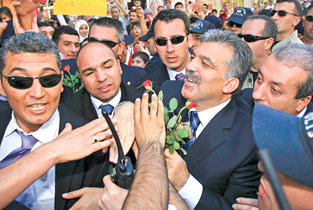
"We don't plan to protest against Abdullah Gül," said pro-Kurdish Democratic Society Party (DTP) Diyarbakır provincial branch head Nejdet Atalay. "We have high expectations from him," he added, explaining that the president's message will be more important than his visit. Atalay told Today's Zaman that whether or not the people of the predominantly Kurdish city will be as receptive and cheerful toward the president as they were during his last visit may depend on what he says. "If he comes here just to exchange greetings on the occasion of the religious holiday, he will lose credibility, because he will be seen as someone who is trying to legitimize the state's policies against the Kurds."
In reference to the conflict between Turkey and the outlawed Kurdistan Worker's Party (PKK), Atalay said people expect the president to declare that "the Kurdish problem is the problem of Turkish society; its solution should be sought through democratic and political means, not with the military; the state should handle the problem; there should be a cease-fire; and [a laying down of arms] should begin." The terrorist PKK claims to be fighting for autonomy in the country's Southeast. It began carrying out armed attacks in 1984.
In the latest attack two police officers were killed and four civilians were injured at the end of November in a clash between the PKK and security forces in southern Turkey on the 30th anniversary of the founding of the terrorist organization.
Observers have noted that the PKK has increased its attacks in anticipation of the March 2009 local election because the ruling Justice and Development Party (AK Party) has increased its strength in the region, as was seen in the 2007 general elections, and dealt the PKK heavy blows with military operations.
Şah İsmail Bedirhanoğlu, chairman of the Southeastern Anatolia Businessmen's Association (GÜNSİAD), said the president's visit is important for easing tensions in the region. Noting that they do not have any information about the president's schedule yet, Bedirhanoğlu added that they had spoken to President Gül about their expectations before.
" We told him about our expectations regarding social and economic measures that need to be taken. And the only key to the solution of the problems is more democracy and more freedom," Bedirhanoğlu said.
A group of representatives from 17 civil society organizations from southeastern and eastern Anatolia met with President Gül in April to share their views on economic and democratic solutions to the Kurdish issue. They also presented a report, titled " The Kurdish Problem and the Region's Socioeconomic State," which provides detailed suggestions for ending the Kurdish problem.
Turkey's Kurds demand language and cultural rights, but the government has fallen short of delivering despite its promises. There have been minor reforms, such as allowing a few hours of Kurdish broadcasting on the radio and a few social measures, but little has been done to address the Kurds' underlying grievances. Poverty, underdevelopment and low standards of education compared to the rest of the country continue to create a sense in the Southeast that Kurds are second-class citizens.
Political science expert Professor Mümtaz'er Türköne, said President Gül's visit to the region carries symbolic importance. " I don't think he will announce a new initiative there," he said. " It's an elegant step to contribute to peace and quiet. That is enough."
However, Kurdish intellectual Ümit Fırat said the people of Diyarbakır may be hesitant to show much warmth toward President Gül compared to the last time he visited the region following to his election to the presidency more than a year ago.
" If people show as much support for President Gül [as last time], this could be seen as getting closer to the state. I don't think they will have the same courage to cheer the president as they did before," Fırat said, referring to perceptions in Diyarbakır, which is a symbolic city for the DTP because pro-Kurdish parties have dominated local elections there for the past two decades.
DTP Diyarbakır deputy Selahattin Demirtaş also said they expect President Gül to deliver concrete messages about a solution to the Kurdish problem.
On the other hand, AK Party Diyarbakır deputy Kutbettin Arzu said the people of Diyarbakır will show kindness toward President Gül, as they did last time. " Nobody should have any doubt about that," he added.
Because of security concerns, the president has previously refrained from announcing his official visit plans until the last minute, especially for politically sensitive regions.


