

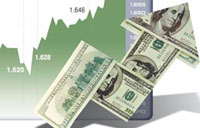
The appreciation of the euro, on the other hand, remained limited compared to that of the dollar. It has increased only 0.75 percent against the lira since the beginning of 2009, reaching TL 2.142 yesterday. The British pound has gained 3.1 percent and hit TL 2.33 from its 2.26 level at the end of 2008.
The depreciation of the lira was the main topic discussed by Foreign Trade Minister Kürşad Tüzmen yesterday as he spoke with a group of reporters during a flight to Egypt, where he was heading with more than 100 businessmen to establish new business bridges for reinvigorating mutual trade. He was sure the dollar would not fall below 1.65, a new point of equilibrium, against the lira again for a long time. The minister called on Turkish businessmen to set their business plans according to this assumption in order to stave off losses that may arise from miscalculations of the possible levels of the currency. He said he would have liked to have seen the lira at this level against the dollar much earlier, in 2003. Tüzmen asserted that if the exchange rate had been close to current levels at that time, Turkey would today have a current account surplus instead of a near $40 billion deficit. "The trade deficit, on the other hand, would be just $4 billion instead of over $70 billion," he added.
Evaluating the latest decision of the Turkish Central Bank to boldly slash interest rates by 200 basis points, beyond even the most optimistic expectations, Tüzmen praised the bank's courage but criticized the timing in taking the decision on interest rates. "Such decisions have positive effects if they are taken at the right time. Had the central bank cut the rates earlier, we wouldn't be importing as much as we are now. We wouldn't be suffering the pressure of huge import bills, and this has significantly affected us," he said.
Yunus Kaya, a research specialist at Gedik Investment, estimates that the rise in the dollar may continue for a bit longer. According to Kaya, expectations that Turkey may face difficulties in finding dollar sources in 2009, fueled by sliding foreign holdings amid increasing capital outflows, have triggered a sharp rise in demand for the dollar. He also pointed out that the delay in signing a stand-by deal with the International Monetary Fund (IMF) and the deepening fallout from the global economic crisis have contributed to the recent hike of the dollar in the domestic markets. Kaya acknowledged that the dollar is facing a large sell-off wave every time it tests the TL 1.7 level, but it may surpass this threshold if conditions get worse in the days ahead. "The central bank had previously announced that it would intervene in the market by selling dollars if the currency rate exceeds the 1.75 level. With the recent slash in interest rates, the bank may move this point of intervention to an even higher level," he said. Kaya stipulated that signing a stand-by agreement with the IMF are two major factors that may cause currency rates to fall again.


