

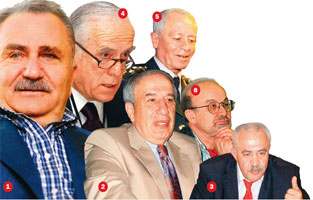
Nearly 40 individuals were detained yesterday in simultaneous police operations staged in six cities as part of the ongoing investigation into Ergenekon, a shady clandestine network of groups and individuals accused of plotting to overthrow the government. The new detainees include military officers, an academic with left-wing political activist background, the former head of the Police Special Operations Unit, seven retired generals, a former senior prosecutor and the former head of the Higher Education Board (YÖK).
The raids, ordered by a court on a query from prosecutors investigating Ergenekon, started in the early morning hours yesterday in six cities, including Ankara, İstanbul, İzmir and Sivas. The first person to be detained was Yalçın Küçük, a professor who in various left-wing journals and parties defended an ideology called the National Democratic Revolution. Küçük's computer and some of his documents were seized during the operation.
Another person who was detained was Erdal Şenel, a retired senior general who worked as the legal undersecretary of the General Staff. Tenel was still in his post during the Feb. 28, 1997, period, which started with an unarmed military intervention that forced the government to resign.
Retired Gen. Kemal Yavuz; retired Col. İlyas Çınar; former head of the Special Operations Unit of the National Police Department, İbrahim Şahin; and Independent Republican Party (BCP) Deputy Chairman Engin Aydın were also detained. Tuncer Kılınç, another retired general, was also detained.
Eleven people, including a navy captain and a senior police officer, were detained in Sivas in yesterday's operations. The police officer was identified as E.E., while the identity of the navy captain was withheld.
The police found 22 hand grenades, four revolvers and one Kalashnikov rifle in the house of a lieutenant colonel detained yesterday as part of the operation in the city of Adapazarı, officials said.
Police intelligence indicated that the 10 people detained in Sivas on suspicion of Ergenekon membership were planning sensational assassinations, Sivas Gov. Veysel Dalmaz announced yesterday at a news conference. Two hand grenades, a penshaped gun, 36 bullets, a large number of unlicensed rifles and other ammunition were found during the raids, the governor said.
Speaking to the police after his client's arrest, Yalçın Küçük's lawyer Levent Gök said the search in Küçük's home was conducted under a search-and-capture warrant issued by the İstanbul 9th High Crime Court.
Gök said both of Küçük's homes were searched by the police, who seized all the CDs and documents inside the houses. Gök said his client had maintained his high spirits and had been cooperative. " He, with his known views, is a public figure, a very select and special intellectual. He is a valuable writer of ours who has greatly contributed to democracy in our country. All of Turkey knows Mr. Küçük's views both from his published articles, books and appearances in the media.
" He, too, has failed to understand why this order to search his home was given. He is a lover of our republic, a modern and contemporary individual who believes in democracy. We believe that pressure and threats against our intellectuals and writers will negatively influence the democratic environment
in our country," he said, adding that his client would be questioned at the Ankara Police Department.
Dalan to cut short US trip
Bedrettin Dalan, a former mayor of İstanbul and president of the İstek Foundation's board of trustees, is also being sought as part of the Ergenekon investigation warrant. But when the police searched Dalan and his assistants' offices and an office at Yeditepe University owned by the İstek Foundation, they found that Dalan was abroad in the US. In a statement made later in the day, Dalan said he would be cutting his trip short and coming back to Turkey early because of the investigation.
CHP deputies react to Ergenekon investigation
Meanwhile, yesterday Republican Peoples' Party (CHP) Deputy Chairman Yİlmaz Ateş criticized the Ergenekon operation, accusing the Justice and Development Party (AK Party) government of being behind the investigation. " The AK Party is waving the sword of Ergenekon like the sword of Damocles above anyone who publicly shares his or her opposition to the AK Party," Ateş said. " That sword will one day return and stab them."
A criminal court in Istanbul began trying 86 suspects, 45 of whom are being held in prison, in the Ergenekon terrorist organization case on Oct. 20. Among the suspects are several retired generals, including one who headed an ultra-Kemalist organization that organized massive anti-government rallies in 2007; other retired army officers; a number of mafia bosses who were also ultranationalist youth leaders in the '70s and '80s; an ultranationalist lawyer who filed charges of " insulting Turkishness" against various intellectuals -- including writer Orhan Pamuk -- over statements that contradicted the state's position; journalists; drug lords; the spokesperson of a dubious organization called the Turkish Orthodox Patriarchate; academics, including the former rector of the İstanbul University; and a Council of Forensic Medicine expert, among others. A number of people currently jailed on charges of Ergenekon membership were also detained or called to testify in the Susurluk investigation of 1996, which revealed similar shady links between a police
chief, a politician and the crime world.
The indictment, made public in July, accuses the Ergenekon network of being behind a series of major political assassinations over the past two decades. The victims include a secularist journalist, Uğur Mumcu, long believed to have been assassinated by Islamic extremists in 1993; the head of a business conglomerate, Özdemir Sabancİ, who was shot dead by militants of the extreme-left Revolutionary People's Liberation Party/Front (DHKP/C) in his high-security office in 1996; secularist academic Necip Hablemitoðlu, who was also believed to have been killed by Islamic extremists, in 2002; and a 2006 attack on the Council of State that left a senior judge dead.
Alparslan Arslan, found guilty of the Council of State killing, said he attacked the court in protest of an anti-headscarf ruling it had made. But the indictment contains evidence that he was connected with Ergenekon and that his family received large sums of money from unidentified sources after the shooting.
The indictment also says retired Gen. Veli Küçük, believed to be one of the leading members of the network, had threatened Hrant Dink, a Turkish-Armenian journalist slain by a teenager in 2007, before his murder -- a sign that Ergenekon could be behind that murder as well. Küçük was also detained but later released in the Susurluk affair of 1996.
Suspects began appearing in court on Oct. 20, facing accusations that include " membership in an armed terrorist group," " attempting to destroy the government," " inciting people to rebel against the Republic of Turkey" and other similar crimes.


