

Kuştepe was known as one of the strongholds of the Hizbullah organization, which was reportedly established and supported by JİTEM to fight the outlawed Kurdistan Workers' Party (PKK) by exploiting the religious sensitivities of the people of southeastern Anatolia. It has also been reported that retired Gen. Veli Küçük, one of the key suspects in the trial of Ergenekon, a clandestine network charged with attempting to foment chaos and undermine stability for the ultimate purpose of a coup d'état, was the founder of Hizbullah.
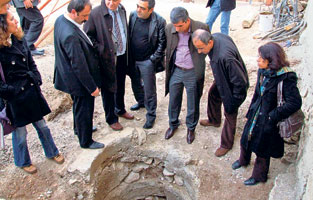
During Monday's excavations in Kuştepe, security forces brought a Hizbullah informant to point out where to dig. Security forces also raided the house of Kamil Atak, a village guard in Kuştepe and the former mayor of Cizre, but he was not home. Five others, all members of Atak's family, have been detained as part of the investigation into the Kuştepe bones.
 Police detained five people yesterday after finding bone fragments at a site in Şırnak's Cizre district. Investigators have been excavating wells and fields in the Southeast that are believed to be mass graves where hundreds of Kurdish civilians who went missing in the 1990s are buried. |
The excavations in Kuştepe took place upon the orders of a high criminal court in Diyarbakır that has a regional mandate as well. The excavations on Monday took place without advance notice, considered crucial by lawyers and human rights activists.
Last week there were excavations at two other sites in Şırnak upon the orders of a local court and with prior notice to the public. There were claims that because people knew about the excavations beforehand, some of the death wells were " cleaned up." Despite these allegations, a human skull, burnt clothing and bones were found during last week's search.
Nuşirevan Elçi, the chairman of the Şırnak Bar Association, noted that there were more places, fields and wells that must be searched for remains of missing persons and that their association had already demanded more excavations. But Elçi claimed that prosecutors' offices should take immediate action and should launch excavations without advance warning.
Sezgin Tanrıkulu, a former chairman of the Diyarbakır Bar Association, underlined that the locations of the death wells are known among the people, but prosecutors' offices are in need of evidence and tips, adding that new laws should be passed encouraging informants to tell authorities what they know.


