

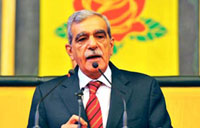
During his speech Türk recalled that Feb. 21 is celebrated as " International Mother Language Day," adding everyone should be free to use one's native language. " No one opposes the fact that Turkish is the official language of Turkey. What we want is the lifting of the ban on the use of Kurdish. This is a humanitarian demand. As today is International Mother Language Day and due to the ban on Kurdish, I will continue my speech in Kurdish," he said and started to address the audience in Kurdish.
The state-owned TRT 3, which was broadcasting the parliamentary group gathering live, immediately stopped its broadcast when Türk switched to Kurdish. TRT 3 said it had cut off Türk's speech because Turkey's Constitution states that Turkish is the country's official language. It also apologized to its viewers. In his remarks in Kurdish Türk mentioned the suffering of the Kurds after their mother tongue was banned. " The military seized control of Parliament in 1980.
Many Kurdish youngsters were put in prison. People who did not speak Turkish wanted to speak in their mother tongue with their children in prison. However, as they were not allowed to do so, their children had to leave with broken hearts," he said.
The public use of Kurdish was prohibited following a 1980 military coup and was in place until 1991. The ruling Justice and Development Party (AK Party) has recently taken significant steps in a bid to reconcile with its Kurdish population. Among the steps was the dedication of one of the Turkish Radio and Television Corporation's (TRT) channels to broadcasting in Kurdish in a bid to fulfill a long-sought demand from the country's Kurds.
The launch of the new channel, TRT 6, was welcomed by the majority of the Kurdish population as a late but pleasing move that could strengthen unity between Turks and Kurds.
Soon after his speech Türk spoke to reporters and said he did not inform Parliament Speaker Köksal Toptan about his desire to speak in his mother tongue. " This was a party decision. I spoke about the beauty and richness of languages. If the prime minister can speak in Kurdish, so can I," he said.
In early January, Prime Minister Recep Tayyip Erdoğan delivered his congratulatory message for the launch of TRT 6 in Kurdish, in which he said " May TRT 6 be beneficial for Turkey."
Türk drew mixed reactions from individuals inside and outside of Parliament for speaking in Kurdish during his speech. Views differed as to whether Kurdish politicians should be allowed to address Parliament in their mother tongue.
The Office of the Parliament Speaker said Türk openly violated the Constitution when he spoke in Kurdish in Parliament. In a written statement, the office said Parliament is a constitutional institution, adding deputies have to use the official language of the state -- Turkish -- in all legislative acts. " Legislative acts include parliamentary group gatherings of political parties as well. The use of a language other than Turkish amounts to violating the Constitution," the statement read.
 The leader of the pro-Kurdish Democratic Society Party sparked controversy when he began speaking Kurdish during his party's parliamentary group meeting yesterday. |
Nihat Ergün, deputy chairman of the AK Party's parliamentary group, called Türk's speech a " provocation" and said under Parliament's roof, messages should be given in a common language.
Nationalist Movement Party (MHP) Secretary-General Cihan Paçacı said Türk's move can never be appreciated, adding that the government was responsible for the incident. " When a Kurdish channel was launched through the initiative of the government, the path was cleared for such incidents. Türk's move is certainly not approved of," he noted, adding a Kurdish politician would feel free to speak in Kurdish in a country where the prime minister uses that language.
Main opposition Republican People's Party (CHP) deputies expressed a similar view, noting that they did not approve of the use of Kurdish in Parliament. " The speech was delivered under the roof of Parliament. Turkish is spoken in Parliament. We denounce Türk's move and call on related bodies to do what is necessary," they said. Claims that Supreme Court of Appeals Chief Prosecutor Abdurrahman Yalçınkaya had launched an investigation into the incident have yet to be verified by an official body.
AK Party Hakkari deputy Rüstem Zeydan, on the other hand, said he did not think there was any problem with Türk's speaking in Kurdish in Parliament, naming the move a " significant step in the name of societal peace."
Mehmet Altan, a columnist for Star daily, accused Parliament bylaws for giving rise to such trouble. " As Parliament bylaws date back to the Sept. 12 [1980] coup era, they bear the traces of fascism," he said.
Ömer Laçiner, editor-in-chief of the socialist Birikim monthly, said though Türk may have acted against the law, it is a legal right for individuals to speak in their mother tongues.
" Speaking in Kurdish will not harm the sacredness of Parliament. We should not make problems over this issue," said Galip Ensarioğlu, the chairman of the Diyarbakır Chamber of Commerce and Industry (DTSO).
Does Türk risk facing a Leyla Zana-like scandal?
Türk's move to continue his speech in Kurdish raises the question whether he may face a situation similar to Leyla Zana of the Democracy Party (DEP), a DTP predecessor that was shut down in the past by the State Security Court (DGM).
Zana, who in 1991 came to prominence for taking part of her oath of office in Parliament in Kurdish, was convicted in 1994 by the DGM of links to the Kurdistan Workers' Party (PKK), considered a terrorist group by Turkey, the United States and the European Union. In 2004 she was released after an appeals court overturned her conviction and that of three other former Kurdish lawmakers.
Kurdish politicians frequently face criminal complaints or lawsuits for speaking or making official correspondence in Kurdish.
Türk's switch into Kurdish during his speech also sparked concerns that it may lead to his prosecution and increase tensions ahead of local elections on March 29. The DTP, which has 21 legislators in Parliament, faces closure by the Constitutional Court for its alleged ties to the outlawed PKK. The case is still under deliberation at the court and observers say Türk's move may intensify societal pressure on the top court to shut down the DTP.
The party runs much of Turkey's Kurdish-dominated southeastern provinces and is in fierce competition with Prime Minister Erdoğan's AK Party.
The AK Party plans to win the mayoralty of major southeastern cities, which remain traditional strongholds of Türk's DTP, to consolidate its grip on power and give it momentum to pursue its policies, including a plan to reform the current Constitution -- drafted under military rule -- which is key for Ankara's hopes to join the European Union.
Erdoğan boasted the richness of ethnicities in Turkey in a speech he delivered in southeastern Diyarbakır last Saturday, where he traveled as part of his party's campaigns for the approaching municipal elections.
" The Republic of Turkey is one with all its Turks, Kurds, Abkhazians, Bosnians and Albanians. We have opened our arms to everyone who turned their backs to violence and terror. ... All of us are fundamental elements of this country. All of us are first-class citizens. No one is superior to another. We are all hosts in this country," he said.
This was, however, not the only occasion Erdoğan highlighted the importance of the Kurdish population for his party. He stated on Sunday that his party may spur into action to bring the remains of famous Kurdish singer and songwriter Ahmet Kaya to Turkey. Kaya, who became the target of a harsh media campaign when he expressed his wish to produce music in Kurdish, died of a heart attack in 2002 in France.


