

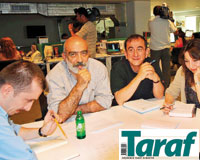
Mehmet Betil, a businessman and a member of the executive board of the Community Volunteers Foundation, struck a partnership deal with the daily last week, saving it from the verge of financial collapse and closure.
As many large companies were reluctant to confront the military, Taraf could not raise enough advertising revenue to meet its expenses. In an attempt to gain some financial breathing room after the drop in revenue, the daily even asked its readers to buy advertisements on its pages so that it could find a way out of the crisis without being obliged to lay off staff. The campaign was greeted with enthusiasm by readers, who lent financial support to the daily through small ads published in their names.
Betil, who made donations to Taraf from time to time, said in an interview with the Sunday's Zaman: "Despite not getting their salaries for months, the daily's columnists, managers and employees continued to work hard. Values are very important for Taraf. I welcome this with respect. I am ready to take risks for the survival of this newspaper." Describing himself as obsessed with freedom of thought, Betil said he was proud to support Taraf, which promotes that value.
In his Jan. 20 editorial Altan talked about difficult times at the newspaper when he even thought about closing down the daily from time to time.
"I reaffirmed my faith in the need for the existence of this newspaper when I read those [pro-coup and pro-military] newspapers. Not only me but everyone else at this paper believed this. My colleagues worked for two-and-a-half months in self-sacrifice without receiving a penny from the newspaper. They had no money to take home, they could not pay their rent, there were even some whose electricity was cut off because they failed to pay their bills, and some could not even find the money to travel to the newspaper's headquarters from their houses," wrote Altan.
At that troubled time, he said, Betil showed up as a savior and presented them with a sum of money, which the daily urgently needed in order to get over an economic bottleneck.
Betil, who does not come from a journalistic background, implied that there had been a change in Taraf's publication policy and said the daily would cover news and commentary, which would draw the interest of broader segments.
"It should be a newspaper based on the freedom of thought that raises its voice against wrongful practices and reaches a wider segment of readers," he added.
A senior editor at the daily, S.M., who did not receive a salary for several months, said she continued working there because she believed it was filling a gap in Turkey and playing a historic role.
She said she and her colleagues at Taraf felt more worried about the prospects of the closure of the daily than their own situations and were about to lose hope when the good news finally arrived.
"Mr. Altan, who was away from the newspaper for a while in search of ways to find money to save the newspaper from closure, promised that he would return with good news. He showed up at the newspaper one day and asked everyone to gather for a meeting where he announced the good news, prompting loud applause from us. Altan expressed his gratitude to each and every person for their support of the newspaper during difficult times," she told Sunday's Zaman in a phone interview.
İhsan Dağı, a professor in the department of international relations at Ankara's Middle East Technical University (METU), said Taraf has been a model of good journalism in Turkey since it began publishing and has not only influenced journalism but politics as well.
"Taraf talked about issues that everyone felt could not be questioned and criticized people who were earlier deemed untouchable."
According to Dağı, some large private companies' reluctance to place advertisements in Taraf to avoid confrontation with the military showed that they are afraid of the state's policies. "Taraf has served to bring about this understanding as well."
As for the Taraf readers who supported the newspaper by giving from their own pockets, Dağı said this proved that despite being small, there is a group of people in Turkey who have a strong belief in democracy.
"I have not heard of any similar case [where readers voluntarily make donations from their own pockets to save a newspaper from closure]," stated Dağı, noting that Taraf's survival will aid efforts to raise Turkey's democracy to an advanced level.
FATMA DİŞLİ İSTANBUL


