

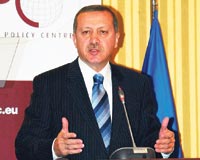
Almost meeting with all the European Union heavyweights, including European Commission President José Manuel Barroso, European Parliament President Hans-Gert Pöttering and EU foreign policy chief Javier Solana, and speaking at two important Brussels think tanks -- namely, the European Policy Centre (EPC) and Friends of Europe -- Erdoğan had one concrete message to convey: His government is strongly committed to revitalizing the reform process to speed up Turkey's European Union membership bid.
On several occasions Erdoğan declared that he was recommitting his government to an intensive reform process in 2009. During his press meeting with President Barroso, he underlined more than once that 2009 would be a year that would witness " a leap forward in terms of reforms," that " 2009 will be a very different year for reforms" and that the " reform process will hasten."
These words have been welcomed by all the Europeans Erdoğan met, but the big question remains: What will he do when he gets back to Ankara ?
European sources speaking to Today's Zaman said there were encouraging steps. The start of Kurdish broadcasting, gestures toward Alevis, the restoration of famous poet Nazım Hikmet's Turkish citizenship and the appointment of a full-time minister for EU negotiations are all welcome steps that could hopefully be strong signals for " a 2009 full of reforms," European diplomats say. They also point out that Erdoğan told his European counterparts behind closed doors he was strongly committed to a reform agenda and would prove so in 2009.
The year 2009 is significant in several respects. First and foremost is Cyprus . Back in 2006, the European Union decided it would take another look at the ports issue related to Cyprus at the end of 2009. If talks over the island lead nowhere, some EU member countries will put pressure on opening the file again and probably seek sanctions. At present, 18 of 33 chapters are already suspended (there are 35 chapters in total, but only 33 are being negotiated), no one dares talk about another fine as that would practically mean the suspension of talks; however, an energetic Turkey like the one between 2002 and 2004 could dispel criticism on Cyprus even if talks are unsuccessful, European diplomats say.
The European Union, which consistently supported Erdoğan's governments after the military released a memorandum on April 27, 2007, during the closure case against his party and during the election of President Abdullah Gül, is somewhat disappointed about the Turkish government's performance since the July 22, 2007 general elections. This silent disappointment could easily turn into harsh criticism in a couple of months unless Erdoğan keeps his promise and starts to deliver in Ankara .
Strongly sharing the prime minister's sensitivities on the Gaza massacres committed by Israel, I need to say that his remarks were a bit out of proportion and misplaced. When speaking at a breakfast organized by the EPC, he spared almost 30 minutes for Gaza and 24 minutes for EU issues. There were many people in the audience who were hoping to listen to the Turkish prime minister talk about his next moves to strengthen Turkey-EU relations in a much more detailed and sophisticated manner during his first visit in four years.
His mixed messages on Nabucco also created a great deal of confusion. Although as the day progressed he retreated from his initial statement -- that Turkey would review its position on the project unless Greek Cypriots unblocked the energy chapter -- his original phrase was quoted widely. Without troubling himself to understand what exactly Erdoğan said, German Economy Minister Michael Glos was quick to condemn him. Glos accused Erdoğan of " political blackmail." which he later clearified strongly stressing that Turkey would never use Nabucco project as a weapon against Europe.
Despite this criticism, Erdoğan's statements were widely admired both by the Europeans and others because of his frankness.
Erdoğan and Gül have been seen as trustworthy politicians in Brussels , meaning they do deliver. Brussels will now closely monitor what the government will do next.SELÇUK GÜLTAŞLI BRUSSELS, BELGIUM


