

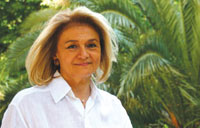
According to Naskali, the " guardianship mentality" present in Turkey works now as it did in the run-up to the May 27 coup, gathering people into city squares and spreading fear with a message that " reactionaries are coming; Shariah is coming." She asserts that had the Ergenekon investigation not made it into the courtroom and had coup plans not been revealed, the events of 1960 would have been relived in Turkey. Naskali also says bringing coup plotters to court is a constitutional duty. Noting that a " coup means a protest," she adds: " It is the duty of the civilian authority, the administration and Parliament to uncover and try in court the coup plotters who aimed to eliminate them. In this sense, what the state is doing in prosecuting Ergenekon is essentially fulfilling its duty." Naskali, a faculty member at Marmara University, is among the most knowledgeable people in Turkey when it comes to the May 27, 1960 coup and the trial period that followed. She has done much work on the official records of the trial of her grandfather, the third president of the Turkey. Bayar's trial took place on Yassıada, and Naskali has written seven books thus far on the trial.
Professor Emine Gürsoy Naskali, a faculty member at Marmara University, is among the most knowledgeable people in Turkey when it comes to the May 27, 1960 coup and the trial period that followed it. She has done significant research on the official records of the trial of her grandfather Celal Bayar, the third president of the Turkish Republic |
Naskali, who was only 10 in 1960 when the coup occurred, spoke to Today's Zaman, describing some of the similarities between Turkey's past coups and the Erge-nekon process now at hand.
Naskali firmly believes that in order for Turkey to be able to put an end to the practice of coups, it must, as a nation, face the mentality behind Ergenekon. She personally considers unsolved murders and manipulation of the national agenda unacceptable and calls for the Turkish military to " go into action." " Finally, these illegitimate projects and events are being questioned. The entire Ergenekon investigation is in some ways a compensation for the coups and unfair acts that have occurred in Turkey for which there was no reckoning," she says.
Naskali notes that the spotlight cast on a journal allegedly belonging to former Naval Forces Commander Adm. Özden Örnek that contains coup plans was a tremendous success in its own right. She comments on those who were behind efforts to reveal these plans, saying: " They worked courageously, and they carried out something very difficult. Professor Emine Gürsoy Naskali, the granddaughter of Celal Bayar and a former member of the Democrat Party's General Executive Council, spoke to Today's Zaman in an exclusive interview. |
Speaking about how coup supporters worked hard to create the appropriate groundwork for their efforts -- one that would legitimize their coup -- Naskali said, " Ergenekon supporters tried to lay the groundwork for a coup in the same way the May 27 coup supporters did." She describes some of the similarities between these two periods, noting: " Right before the May 27, 1960 coup, the military and the opposition worked hand-in-hand to try to set the stage. There are allegations that youth were killed and put through meat grinders, later placed in freezers of the Meat and Fish Corporation and buried under the asphalt of the Ankara-Konya highway. The rector of İstanbul University at the time, Sıddık Sami Onar, said many university students had been killed and that the university would definitely find them. But people were put through meat grinders. And later, the news was issued that these students had betrayed the country and that Kars and Ardahan had been sold to the Russians. And today we see that the guardianship coup mentality is trying to create a similar groundwork. They summon society into city squares, crying, 'Shariah is coming.' They are creating a certain atmosphere. They bring some girl they get from a nightclub, dress her in a chador, have her memorize her lines and then say, 'Religious groups are taking over Turkey.' Turkey then spends months focusing on these made-up events."
 |
Naskali also adds that she doesn't consider the objections made by people to some of the names detained during the course of the Ergenekon investigation very reasonable. " Of course there is a civilian leg to these coups. The Republican People's Party [CHP] helped provoke May 27. It was hoping to take over the administration after the coup," she says. She recalls a declaration made directly in the run-up to the May 27 coup by then-opposition leader İsmet İnönü that was perceived by many as permission to stage the coup.
" After İnönü took care of the military and signed off on the executions, he expected the people who came to power to come to him and surrender to him. ... After the coup, they celebrated. May 27 was a national holiday and was widely celebrated. It was the specific inspirations of the 'intellectual' CHP professors that led to the trial of DP leaders, deputies and supporters. They told the coup planners: 'If you try them and don't find them guilty, then you yourselves will be guilty. You have to make sure you find them guilty of crimes that call for execution. That's the result that must come from this'," she adds.
Discussing various reactions to the Ergenekon investigation that have been seen in Turkey, Naskali notes that while some remained silent about the coup plans that were uncovered, these same factions criticized the arrests that were made. She laments the fact that so many questions have not been asked: " How can you throw citizens into lime pits? Where were these bombs going to be used? Who was going to be sold out? How were those villages flattened?" She notes that instead of these questions, people have asked: " How can people be arrested so early in the morning? What a disgrace; the law is being trampled."
Naskali states that coups have served the interests of both military and civilian figures in Turkey. " The military put its sights on the administration. Civil supporters of the military were made members of the government. People should not think that the coup mentality gives any value to intellectualism. Right after the May 27 coup, 147 professors and lecturers were pushed into retirement with one stroke of a pen. Similar things happened in the military as 235 generals and 4,700 officers were sent into retirement. People who were perceived as being in the opposition were removed," she says.
'The same mentality we see at work in Ergenekon was influential in 1960'" The Justice and Development Party [AK Party] emerged as the clear victor in the July 22, 2007 elections. The following day, Professor Mümtaz Soysal appeared on television and asked publicly, 'Do we have to wait another four years for this party to leave?' This same mentality was at work in 1960. They encouraged certain student activities to guide society. In fact, student protests were depicted as a reason for the coup. After the coup took place, they tried to legitimize it. They maintained that in order to make the coup seem necessary and legitimate, the DP needed to be tried and convicted. In order to hang my grandfather, they even changed the legal code. And then they claimed the law was retroactive."
'Just like before the May 27 coup, they are now using the 10th Year March'" The Plevne March is a wonderful Mehteran [Ottoman marching band] march. It talks about the river Danube. But before the May 27 coup, the words to this march were changed and were turned into words for a march specifically for a coup. The same thing happened years and years after the 33-bullet event of 1943, when in 2004, the name of Mustafa Muğlalı was given to the army barracks in the town of Özalp in the province of Van. This is all happening right in front of people's eyes. The Republican Rallies are accompanied by the 10th Year March and take place to protest the Ergenekon trial. These rallies are not perceived as being attempts to interfere in the course of justice. CHP flags are waved at these rallies. People go to Anıtkabir. On one side, Atatürk is kept, and on the other is İnönü, who didn't have Anıtkabir built for 12 years and who kept Atatürk in wax for all those years at the Ethnography Museum of Ankara. The DP -- elected by the free will of the people -- is counted by them as having been a countermovement against the Atatürk revolution. But in reality it was Celal Bayar, the founder of the DP, who had Anıtkabir built. The moment he became president, his first order of business was to have Anıtkabir built. He spent three years building it, and in 1953, Atatürk was buried there."
'Path forward cleared for those who carried out May 27'"In the run-up to the May 27 coup, on May 21, 1960, cadets in the military academy in Ankara marched with the encouragement of their commanders in the district of Kızılay. Those students who participated in this march as well as the officers who were on duty at Yassıada were all summoned and later appeared before us: Şener Eruygur, Hurşit Tolon, Çevik Bir, Tuncer Kılınç, Altay Tokat, Kemal Yılmaz, Edip Başer, Tamer Akbaş, Çetin Doğan, Yaşar Büyükanıt, Fevzi Tükeri, Akay Şakman, Teoman Koman, İlhami Erdil, Namık Kemal Ersun, Necip Torumtay, İsmail Hakkı Karadayı, Kemal Yamak, İlhan Oral, İrfan Tınaz, Doğu Aktulga... None of these names have ever spoken of what happened at Harbiye or Yassıada. None of them ever said they regretted what happened during the May 27 coup."


