

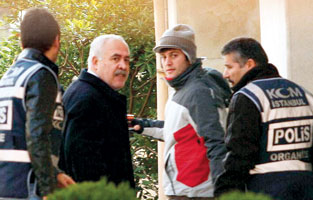
İbrahim Şahin, former deputy chairman of the National Police Department's Special Operations Unit, gave his initial testimony to judges at the 13th High Criminal Court on Sunday. Şahin was arrested on charges of membership in a terrorist organization and violation of Turkey's Firearms Law No. 6136.
Şahin made shocking declarations to the court, saying he was assigned by 7th Army Commander Gen. Bekir Kalyoncu , currently on active duty, to set up a team of 300 officers to be employed in a new anti-terrorism department. Kalyoncu also promised that Şahin would be undersecretary of the new unit. Şahin claimed he has been working to set up this new structure. He said a document titled S-1, listing military officers and police special operations unit members under the age of 30, found in his home during the police search, was a list of officers to be chosen for the special force.
In a prompt statement released shortly after noon, the General Staff denied Şahin's statements. " Certain stories have been published concerning Turkish Armed Forces [TSK] personnel. These stories do not reflect the truth," the brief statement said.
Also in his testimony, Şahin said he had always fought against the terrorist Kurdistan Workers' Party (PKK) during his time with the police department. " I set up the Special Operations Unit in 1993 based on the orders of the Interior Ministry, where I stayed until 1996. I left my post after the Susurluk incident. I was given six months in jail, although I had nothing to do with Susurluk. I was jailed in 2003. I had been permanently disabled in an accident I had in 2000. I was pardoned by the Presidency based on a report from the Forensic Medicine Council. After I retired, not liking where the country was headed, I started writing books to express my opinions. I shared my opinions on local TV stations. I shared the information that the PKK terrorist organization is actually run by Armenians," he said.
In response to questions about a list of people to be assassinated and also a map which led police to an underground weapons cache in Ankara, Şahin told the court he had nothing to do with the plans. " A criminological examination would show that the handwriting there is not mine. Plus they say flamethrowers were found.
The police do not have such weapons, the military does. I could not have done such a thing. If it were me, I would have buried them in more desolate territory, such as in Elmadağ. I had nothing to do with the weapons, and I didn't plan an attack against anyone."
Weapons, flamethrowers and hand grenades were found buried under ground in Ankara's Gölbaşı district after last week's detentions. The site was excavated according to instructions found on a map located in Şahin's house during a police search.
Meanwhile, a new excavation was started yesterday in Ankara's Sincan district based on new evidence acquired during last week's searches.
17 arrested in investigation
Meanwhile, 17 of 33 individuals detained last week as part of the investigation into Ergenekon have been arrested, while 16 others were released, most of them pending trial.
Among those arrested by the courts they were referred to after being detained was Yalçın Küçük, a university professor with a long history of left-wing activism, particularly in the National Democratic Revolution movement, which advocates enlightening the people after a socialist coup to be staged by the military. Küçük was arrested by a court on charges of " membership in a terrorist organization" and sent to İstanbul's Metris Prison.
In addition to Küçük, retired Col. Mustafa Levent Göktaş was also arrested yesterday.
Retired Gen. Erdal Şenel, who allegedly blocked the investigation of members of the military suspected of being part of the clandestine intelligence unit JİTEM, illegally established under the gendarmerie and thought to be part of the Ergenekon network, was released. Retired Gen. Kemal Yavuz and former Higher Education Board (YÖK) head Kemal Gürüz, detained last week, were also released yesterday. Gürüz and Yavuz were released by Ergenekon prosecutors Zekeriya Öz, Nihat Taşkın and Mehmet Ali Pekgüzel. The prosecution referred Şenel and Col. Hüseyin Vural to the court, demanding their arrest. The court released the two retired members of the military, but issued a travel ban on Şenel. Retired Capt. Ataman Yıldırım and Engin Aydın were jailed yesterday.
Küçük's testimony to the police
During his police interrogation, Küçük was asked about his activities prior to the year 1988, sources said. Küçük was questioned about his pictures with jailed PKK leader Abdullah Öcalan and a meeting with the chief terrorist in 1989. Küçük also said he had not had a face-to-face meeting with Ergenekon suspects Doğu Perinçek, who is the leader of the neo-nationalist Workers' Party (İP), and İlhan Selçuk, chief columnist and copyright holder at the Cumhuriyet daily, since the year 1979.
Meanwhile, Gen. Şenel refused to reply to questions from the press after his release yesterday, saying he was " exhausted."
Sources also said that Bedrettin Dalan, a former mayor of the city of İstanbul, who currently is president of the boards of trustees of both the İstek Foundation and Yeditepe University, is being accused of being the financial mastermind behind the Ergenekon organization. A warrant to take Dalan into the custody had also been issued, but Dalan could not be apprehended because was outside the country. In a statement he issued from the United States, Dalan said he was abroad because his wife is undergoing treatment for an illness at a US hospital.
Other claims against him include that Dalan's foundation provided scholarships to children of National Intelligence Organization (MİT) employees and also to poor children who could later act on the organization's ideology. Ergenekon teams arrested in last week's operations were also plotting to kill Turkish-Armenian Patriarch Mesrob Mutafyan, sources claimed.
Ergenekon becomes ETÖ
Meanwhile, the İstanbul Police Department, which released a full list of Ergenekon weapons found in various places in last week's raids, used the acronym " ETÖ" to refer to the Ergenekon terrorist organization. The police department has started to use the acronym not only in its internal correspondence, but also on public statements posted on its Web site.


