

The European Parliament's Committee on Foreign Affairs held its first debate on Tuesday over a draft report concerning Turkey that is full of serious warnings for Ankara, which the draft says has lost its ambition for political reform.
"A clear signal to be given by the Turkish government for proceeding with reforms, which have slowed down over the past three years, will be for the good of both the European Union and Turkey," Dutch Christian Democrat parliamentarian Ria Oomen-Ruijten, who authored the draft report, was quoted as saying by the Anatolia news agency during the committee debate.
" We expect implementation from Turkey, not commitments," Oomen-Ruijten also stressed. Noting that the most important part for a candidate country engaged in the EU membership process was political reform, she called on the Turkish government to vigorously promote its earlier promises for comprehensive constitutional reform.
In the draft report, the European Parliament said it " regrets that the initial effort to reform comprehensively the Constitution resulted in dispute over the headscarf issue and generated further polarization of society; calls on the Turkish government to resume its work on a new, civilian constitution which would place the protection of human rights and fundamental freedoms at its core and urges the government to ensure that political parties and civil society, as well as ethnic and religious minorities, are closely involved in this constitutive process."
The current Constitution, dating back to 1982, is a legacy of the coup d'état of Sept. 12, 1980, a military intervention that has had long-lasting effects on Turkey. Moves to change provisions protecting the generals behind Turkey's Sept. 12, 1980 coup ended in misery for those involved; attempts to pass a new and more democratic constitution have been blocked, and endeavors to lighten the military's control over politics -- the strongest legacy of the Sept. 12 coup -- have all failed so far.
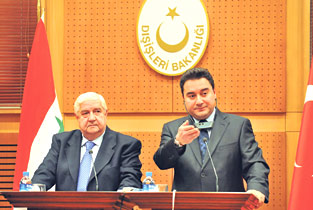
On the day when the draft report on Turkey was being debated in Brussels, Turkish Foreign Minister Ali Babacan was in the same city for a meeting of foreign ministers of NATO member countries and spoke to reporters on the issue.
" Everyone who looks into our National Program will see that Turkey needs a very comprehensive constitutional overhaul. This is a reality and we have to accept this. It is not possible for Turkey to continue with this Constitution forever. Suppose that we try to continue with it, there will then be frequent road accidents and troubles in Turkey," Babacan was quoted as saying by Anatolia, as he underlined that the absence of constitutional reform would spell the absence of a truly stable environment in the country. The minister also noted that there was a need for wide social consensus on the issue.
A senior government official recently told Today's Zaman that changing the Constitution had become next to impossible since the Constitutional Court annulled a constitutional amendment passed in Parliament that would have removed a nearly two-decade-long ban on wearing headscarves on Turkish university campuses.
" The government would like to change every single article of the Constitution except for the four unchangeable articles, and we are the only party that is prepared to change it. However, desire is one thing and reality another," Deputy Prime Minister Cemil Çiçek said at the time, adding that since the Constitutional Court annulled the headscarf amendment, not on procedural grounds but on " substance," it had set a precedent -- namely, that it can overturn any law passed in Parliament, greatly limiting the legislature's powers. " Changing the Constitution has now become as difficult as moving a mountain," he said.
When the court announced its opinion on the ruling in late October, it sparked widespread criticism that it overstepped its powers and encroached on Parliament's territory. Many have concluded that deciding to overrule constitutional amendments which had been properly passed on procedural grounds is tantamount to blocking Parliament from making any future constitutional amendments without the court's approval.


