

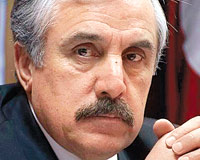
Ensarioğlu, who has claimed for years that using special operations forces to fight terrorism is wrong, shared his latest analyses with Today's Zaman, saying that the Ergenekon case, the rejection of the closure case against the Justice and Development Party (AK Party) and the upcoming local elections are significant for Turkey. Stating that people in the region expect the Ergenekon case to shed light on unsolved murders, Ensarioğlu said: " The public attributed murders committed in the region by unknown perpetrators to the state. If it is proven that they were committed by others, the state would make up with the people."
He recalled that after the 1960 coup, he and his father, also a politician, were exiled along with 64 members of their family. His father died of a heart attack at the age of 49, but Ensarioğlu does not attribute his death to the state. Instead, he places blame on the leaders of the coup. " The Ergenekon case has been politicized," he said. " It has been turned into a 'secularist-anti-secularist' conflict. If the Ergenekon case sheds light on unsolved murders, it would ease the tension in the region." Ensarioğlu said the Constitutional Court's ruling against closing the AK Party was promising for democracy. " The fact that the AK Party received great support from the region in the general elections shows that people in the region pin hope on the AK Party," he said. He also addressed remarks made last month by Prime Minister Recep Tayyip Erdoğan, who said those opposed to the idea of one nation and one state should leave Turkey, and noted the role of the pro-Kurdish Democratic Society Party's (DTP) role in raising tension in the region.
" It is wrong both for the AK Party to make such remarks to get votes from the west and for the DTP to say things to get votes from the Southeast," he said. " It is wrong to increase tension in the region."
He also noted that President Abdullah Gül and Erdoğan carry the burden of easing the tension. Ensarioğlu also recently met with Gül, who is preparing to visit the Southeast, to exchange opinions about the region's problems. After the meeting, Ensarioğlu said Gül is a figure who embraces all of society, and he said he expects Erdoğan to do the same.
Stressing that the unitary structure of Turkey should be preserved, Ensarioğlu said the definition of citizenship should be discussed again. " We all accept one language and one flag under a unitary system. Yet, the idea of one nation can be misunderstood," he said. " There are also Kurds and Zazas. Citizenship in the Turkish Republic is enough for all of us."
Ensarioğlu also proposed solutions for the region's problems. " Citizenship should be redefined by a constitutional change," he said. " The Kurdish and Zaza languages should be freed; the common official language should be Turkish. An amnesty should be granted for those related to outlawed Kurdistan Workers' Party [PKK], but the borders of this amnesty should be discussed with those who are not a party to the problem. Those who ran to the mountains but did not use weapons should be given a way out. The punishment for those who used weapons can be reduced with the condition that they will not commit the same crime for five years."
Stating that occupational training should be encouraged in the region, Ensarioğlu said investors who would establish factories in the region would require qualified workers. Noting that rehabilitation facilities for street children should be also improved, he said new rehabilitation centers should be founded. He said the state should make investments in the region in the fields of education, health and the economy, which are crucial in preventing youth from heading to the mountains. Ensarioğlu finally noted that the problems could not be solved in the region because of the fears of the state. " If Turk-Kurd, secularist-anti-secularist conflicts come to an end in Turkey," he said, " more promising days will arrive for Turkey."


