

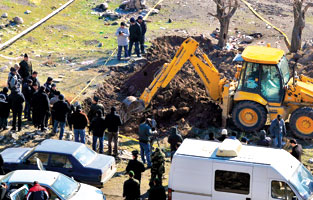
The police yesterday carried out a series of digs in wasteland around the capital in a search for weapons linked to the Ergenekon terrorist organization. The excavations are a continuation of earlier digs based on new documents obtained during police raids on the houses and offices of arrestees last week. Police on Monday discovered several explosives and bullets in Ankara in excavations carried out under the auspices of the Ergenekon investigation. They unearthed 30 hand grenades, nine smoke bombs and hundreds of G-3 rifle bullets in the garden of a deserted house in Sincan, an Ankara suburb. The hidden weapons not only give clues to the organization's planned attacks in the future, but also may shed light on past crimes believed to be committed by the organization.
Yesterday's excavations started out early in the morning in Yenikent, an area not far from the site of the cache found in Monday's digs. The excavation was briefly halted, as the area is a historical site, a status given to it only a week ago, but then was restarted when Turkey's Museums and Monuments Directorate gave it the green light. Only the Anatolia news agency and the Turkish Radio and Television Corporation (TRT) can record footage at the site.
Meanwhile, an ancient jug was found during yesterday's excavation. Archeologists are yet to examine the artifact, officials said.
Lieutenant colonel investigated
The military started an investigation yesterday into Lt. Col. Mustafa Dönmez, an Ergenekon suspect whose houses in Sakarya and Ankara were found in last week's operations to contain dozens of bullets, hand grenades and weapons. Dönmez, who disappeared last week, turned himself into the police yesterday.
" The legal investigation regarding the suspect and the seized materials is continuing in all dimensions," a statement from the military said on the inquiry into the army officer.
A new wave of detentions last week in the Ergenekon investigation revealed that the group was planning to assassinate Alevi and Armenian community leaders, the prime minister and members of the Supreme Court of Appeals, acts that would have dragged Turkey into chaos if they had been carried out.
Thirty-seven individuals were detained last week in simultaneous police operations staged in six cities as part of the ongoing investigation. The new detainees include military officers, a controversial academic with a background of left-wing political activism, the former deputy head of the Police Special Operations Unit, seven retired generals and the former head of the Higher Education Board (YÖK). The YÖK chairman was released after investigation, but four military officers, the controversial academic and the former police deputy chief were arrested. Two senior generals were released pending trial.
Information on weapons in Gölbaşı
The prosecutors in the case indicated that the police had evidence that Ergenekon was plotting to kill prominent Alevi community leaders such as Ali Balkız and Kazım Genç, as well as Sivas Armenian Community President Minas Durmaz Güler along with a number of journalists.
Prior to Monday, two separate weapons depots were found during last week's operations. On Friday the police discovered a weapons cache buried in a forest in Ankara's Gölbaşı district through a map found in the home of one of the newest suspects. Searches in five other areas were also launched based on evidence seized by police during sweeps of homes and offices of suspects. These searches yielded no results.
In Gölbaşı, officers discovered 30 hand grenades, three flame-throwers, many plastic explosives, ammunitions for Uzi machine guns and other ammunition buried close to a road near the capital, officials said. Separately, a weapons cache was found in Lt. Col. Dönmez's İstanbul house.
Weapons found as part of the probe last Friday buried underground in Ankara's Gölbaşı district seem to match assassination plans found in the home of Ergenekon suspect and former Special Operations Unit Deputy Chief İbrahim Şahin.
Meanwhile the National Intelligence Organization (MİT) yesterday confirmed the newspaper reports that Şahin, in his initial testimony to judges at the 13th High Criminal Court on Sunday, said he had informed MİT about intelligence prior to an Oct. 3 outlawed Kurdistan Worker's Party (PKK) attack on a military outpost that left 17 soldiers dead. MİT said the agency has no institutional contact with Şahin, but said Şahin's intelligence had been carried to the agency through " a social interaction."
|

|

|

|

|

|


