

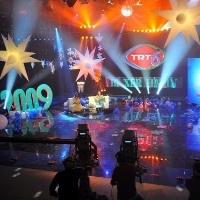
Higher Education Board (YÖK) President Yusuf Ziya Özcan has announced plans to open Kurdish language departments in two prominent Turkish universities in Ankara and İstanbul. Speaking at a reception held on the occasion of the inauguration of TRT 6, Özcan said the board was working on plans to open Kurdish language and literature departments at İstanbul University and Ankara University. " We have received a request from Dicle University for the opening of such a department, but we plan to open one at Ankara University and another at İstanbul University, both of which are very experienced with language and literature departments," he said.
Özcan added that the board may later consider opening Kurdish institutes. In the meantime, many hailed the start of TRT 6, which has been broadcasting in Kurdish since Thursday and called it a positive step in the right direction.
" I hope the Kurdish broadcasting will cement the unity and solidarity of our nation. With the new channel, everyone will see that all of us are the owners of this country, that all of us are equal citizens and that all of us can express the beauties of our cultures in the best manner," said President Abdullah Gül on Thursday in a congratulatory message.
The state-owned Turkish Radio and Television Corporation (TRT) began its full Kurdish broadcasting on Thursday at 7 p.m. local time. The public use of Kurdish was prohibited following a 1980 military coup until the year 1991. The dedication of one of TRT's channels to broadcasting in Kurdish was welcomed as a late, but pleasing, move that could strengthen unity between Turks and Kurds.
Prime Minister Recep Tayyip Erdoğan said, " May TRT 6 be beneficial," in Kurdish during a news conference on Thursday upon his return from a tour of the Middle East. He had spoken the same sentence earlier in an interview with TRT 6. He also voiced his support for the channel and said it would pave the way for further steps in the future. " As you know, the private sector does not get engaged in such things unless the state takes a step. In time, more will happen. We need to be a bit patient," he noted.
Erdoğan also said the Kurdish channel would strengthen unity and improve democracy in the country. "As defined in the Constitution, the Republic of Turkey is a democratic, secular and social state governed by the rule of law. All of our citizens have equal rights and freedoms. The scope of democracy is wide in our country. Everybody has the right and opportunity to express himself. Broadcasting in Kurdish is one of best testaments to this fact," he added.
The new channel was welcomed by intellectuals, too. Ümit Fırat, a Kurdish writer, said the launch of broadcasts in Kurdish on a state channel was a late, but very positive development. "I hope the state will make up for lost time in a very short period of time. The launch of this channel will help eradicate bans. Kurds will no longer feel that their language is something to be ashamed of. This will strengthen unity in the country," he added.
Another Kurdish writer, Altan Tan, indicated that the armor of the official ideology toward Kurds had finally been pierced by the new channel. "It was previously claimed that no such people as Kurds existed and that no such language as Kurdish existed. The state has finally come to accept the existence of Kurds and Kurdish," he remarked.
Former President Kenan Evren, the leader of the 1980 coup, had said in the past that the word Kurd came from the "kart kurt" sound people in the Southeast made when they walked in the mountains in the snow. His comment was interpreted as an attempt to deny the existence of Kurdish culture.
"However, Kurds are still faced with serious problems. While the letters W, X and Q are allowed to be used on the new Kurdish channel, Kurds who use them in their writings face the risk of imprisonment. I believe that TRT 6 should not be a victim of politics. Efforts toward democratization should not lose momentum. There are still many steps to be taken. The state should continue its efforts," Tan added.
This is not the first time Turkey has launched broadcasts in Kurdish. Seeking to boost the country's bid to join the European Union, TRT broke a longstanding taboo with the initiation of weekly 30-minute broadcasts in Kurdish in 2004.
The programs, however, were criticized for their poor quality and content. They were usually uninteresting and old documentaries about nature and history, immediately followed by broadcasts in another language, such as Bosnian or Azeri. They didn't stand a chance next to Roj TV, one of the main propaganda tools of the outlawed Kurdistan Workers' Party (PKK), which is regarded as a terrorist organization by Turkey, the United States and the EU.
Broadcasts in other languages soon
TRT Director General İbrahim Şahin said on Thursday that they were working on projects to launch broadcasts in other languages, including Arabic, Farsi and English. He did not give an exact date for these broadcasts. Tahin had previously announced that a TRT radio channel would begin airing Armenian broadcasts in February. TRT is also planning to create an Armenian Web site and it is working on a project to launch an Armenian television channel in one year.
Şahin also dismissed claims that the ruling Justice and Development Party (AK Party) government would use the new Kurdish channel as a tool for the upcoming local elections, slated for March 29. "We have a broadcasting policy that aims at bringing all people living within the borders of this country closer to one another and eliminating difficulties in communication between those who use different languages. This is not an investment for elections, as some claim," he stressed.
TRT 6 was previously perceived in some Kurdish circles as a "calculated move" by the government ahead of local elections.
AK Party deputy from Van Gülten Orhan sang the Kurdish song "Dotmam" (Uncle's Daughter) for the TRT 6 opening ceremony on Thursday evening. She was greeted with enthusiastic applause.
Culture and Tourism Minister Ertuğrul Günay also delivered a speech at the event in which he said he was commemorating Ahmet Kaya, a famous Kurdish folk singer who died in 2000.
"The new Kurdish channel is a very well-intentioned, but late, initiative... Turkey suffered greatly with irrational practices that aimed to ban people's rights. Feeling the joy of a good step tonight, I also commemorate such Kurdish figures as Ahmet Arif, Ahmet Kaya, Mehmet Uzun and Musa Anter in sorrow," Günay said.
State Minister Mehmet Şimşek termed the launch of full Kurdish broadcasting as a giant step toward the structuring of a more tolerant and democratic society. He said he hoped TRT 6 would serve as a tool for the strengthening of unity and solidarity in Turkey. "Turkey is a strong and rich country. I don't mean richness only in terms of economy, but also in terms of culture and ethnicity. Let's reveal, share and protect all this wealth. There is nothing to be afraid of," he added.
No deputies from the pro-Kurdish Democratic Society Party (DTP), the main opposition Republican People's Party (CHP) or the opposition Nationalist Movement Party (MHP) attended the event.
Baykal slams Kurdish broadcasts
Republican People's Party (CHP) leader Deniz Baykal harshly criticized the launch of TRT 6, which he described as a move that went against the "basic understanding of the state."
"Everybody can air broadcasts in their own language. This is their right. But it is not right to spend the money of the state and 70 million people in line with the ethnic demands of a certain group of our citizens. The duty of the state is not to encourage ethnic identities. Turkey is heading in the wrong direction. They [the government] either know they are doing a very dangerous thing or don't know what they are doing," he said yesterday.
Locals enjoy watching TRT 6
Locals in several predominantly Kurdish eastern and southeastern provinces watched the new Kurdish broadcasting with great interest. In the southeastern province of Mardin, Abdulkadir Çelik said the Turkish state had demonstrated the value it sees in its citizens with the new channel. "I believe the Kurdish channel will serve the purpose of restoring a peaceful atmosphere in our country. The understanding of fraternity among these people will prevail forever," he said.
Şefik Gökçe, from Diyarbakır, noted that the Kurdish population would be able become integrated with the state thanks to TRT 6. "This is a historic move. I wish it was made years ago. However, it is still not too late. I believe people will trust the state more," he said.
Gaffari Çıplak expressed happiness over hearing Prime Minister Erdoğan speaking in Kurdish. "I watched our prime minister say 'TRT şeş bi xer be' [May TRT 6 be beneficial]. His pronunciation was great. I felt he was one of us. I wish this TV station had been launched 30 years ago. Then so many people would not have died and no such organization as the PKK would have existed," he explained.
BETÜL AKKAYA DEMİRBAŞ İSTANBUL


